Chat Live
 Contact Us
 sales@valuetronics.com


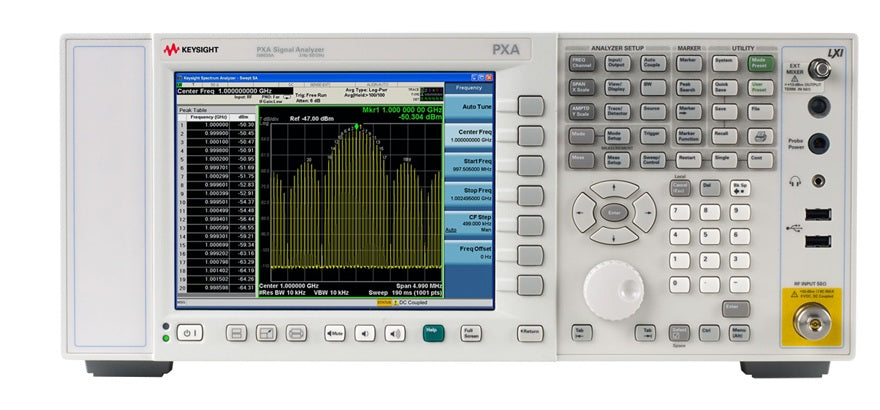
The Agilent N9030A PXA is an X-Series signal analyzer positioned as a future-ready, evolutionary replacement for an existing high-performance analyzer. It spans frequencies from 3 Hz to as high as 50 GHz depending on the configured frequency option, and is built to reveal new levels of signal detail with outstanding RF performance while refreshing legacy systems with a highly compatible replacement.
The PXA is intended for demanding applications in aerospace, defense, and commercial communications. Its stated value is helping engineers sustain past achievements, enhance current designs, and accelerate future innovations — increasing test throughput and protecting existing system investments as measurement needs grow.
ValueTronics stocks test and measurement equipment in its own 20,000 sq ft secure warehouse at 1675 Cambridge Drive in Elgin, Illinois. Every pre-owned unit is inspected and functionally verified in-house before it ships, while new units ship factory-sealed exactly as received from the manufacturer.
Agilent Technologies was spun out of Hewlett-Packard in 1999 as a dedicated test and measurement company. In 2014, Agilent's electronic measurement business was separated again to form Keysight Technologies, which carries the line forward today.
The N9030A PXA is offered as an X-Series signal analyzer family in which frequency reach is set by the chosen frequency option. All configurations share the same 3 Hz low-frequency limit, while the upper frequency extends to 3.6 GHz (Option 503), 8.4 GHz (508), 13.6 GHz (513), 26.5 GHz (526), 43 GHz (543), 44 GHz (544), or 50 GHz (550).
Across the family, the core architecture — PowerSuite measurements, the I/Q analyzer, Noise Floor Extension, and the standard interface set — is consistent. What changes between configurations is primarily the frequency span and the associated RF front-end hardware.
Each pre-owned configuration below is its own dedicated product page with condition-matched pricing. Select the frequency option that matches your application's upper frequency requirement to reach the corresponding page.
Within the family, the configured frequency option determines not only the analyzer's upper frequency but also the available preamplifier coverage and the front-panel RF input connector type.
The configurations differ chiefly in upper frequency limit, which steps from 3.6 GHz through 50 GHz across Options 503 to 550. The standard RF input connector is Type-N female on the 3.6 to 26.5 GHz options (503, 508, 513, 526) and 2.4 mm male on the millimeter-wave options (543, 544, 550); an APC 3.5 mm input is available via Option C35 with Option 526.
Preamplifier coverage also tracks the frequency option: Options P03 through P50 extend from 9 kHz up to 3.6, 8.4, 13.6, 26.5, 43, 44, or 50 GHz respectively. See the comparison table for the per-option frequency ranges, connector types, and related differences.
| Model | Max Frequency | Min Frequency | RF Input Connector |
|---|---|---|---|
| N9030A | 3.6 GHz | 3 Hz | Type-N female |
Additional differences in specifications beyond the few shown above are not listed here — see each model's full specifications below.
| Specification | Value |
|---|---|
| Frequency and Time | |
| Frequency range (DC coupled) | 3 Hz to maximum frequency of instrument (option dependent; up to 50 GHz) |
| Frequency range (AC coupled) | 10 MHz to maximum frequency of instrument |
| Precision frequency reference aging rate | ± 1 x 10⁻⁷ / year; ± 1.5 x 10⁻⁷ / 2 years |
| Temperature stability (20 to 30 °C) | ± 1.5 x 10⁻⁸ |
| Temperature stability (full temperature range) | ± 5 x 10⁻⁸ |
| Achievable initial calibration accuracy | ± 4 x 10⁻⁸ |
| Marker frequency counter resolution | 0.001 Hz |
| Frequency span range | 0 Hz (zero span), 10 Hz to maximum frequency of instrument |
| Frequency span resolution | 2 Hz |
| Sweep time range (span = 0 Hz) | 1 µs to 6000 s |
| Sweep time range (span ≥ 10 Hz) | 1 ms to 4000 s |
| Sweep trigger sources | Free run, line, video, external 1, external 2, RF burst, periodic timer |
| Sweep (trace) point range | 1 to 40001 |
| Resolution bandwidth range (–3.01 dB) | 1 Hz to 3 MHz (10 % steps), 4, 5, 6, 8 MHz |
| RBW selectivity (–60 dB/–3 dB) | 4.1:1 nominal |
| EMI bandwidth (CISPR compliant) | 200 Hz, 9 kHz, 120 kHz, 1 MHz (Option EMC required) |
| EMI bandwidth (MIL STD 461E compliant) | 10 Hz, 100 Hz, 1 kHz, 10 kHz, 100 kHz, 1 MHz (Option EMC required) |
| Video bandwidth range | 1 Hz to 3 MHz (10 % steps), 4, 5, 6, 8 MHz, and wide open (labeled 50 MHz) |
| Maximum analysis bandwidth (standard) | 10 MHz |
| Maximum analysis bandwidth (Option B25) | 25 MHz |
| Maximum analysis bandwidth (Option B40) | 40 MHz |
| Maximum analysis bandwidth (Option B1X) | 140 MHz |
| Amplitude Accuracy and Range | |
| Measurement range | Displayed average noise level (DANL) to maximum safe input level |
| Input attenuator range (3 Hz to 50 GHz) | 0 to 70 dB in 2 dB steps |
| Electronic attenuator (Option EA3) range | 0 to 24 dB, 1 dB steps; full range (mechanical + electronic) 0 to 94 dB, 1 dB steps |
| Maximum safe input — average total power | +30 dBm (1 W) |
| Maximum safe input — peak pulse power | +50 dBm (100 W), < 10 µs pulse width, < 1 % duty cycle, input attenuation ≥ 30 dB |
| Maximum DC (DC coupled) | ± 0.2 Vdc |
| Maximum DC (AC coupled) | ± 100 Vdc |
| Display range (log scale) | 0.1 to 1 dB/division in 0.1 dB steps; 1 to 20 dB/division in 1 dB steps (10 divisions) |
| Scale units | dBm, dBmV, dBµV, dBmA, dBµA, V, W, A |
| Total absolute amplitude accuracy at 50 MHz | ± 0.24 dB (± 0.19 dB 95th percentile) |
| Reference level range (log scale) | –170 to +30 dBm in 0.01 dB steps |
| Reference level range (linear scale) | 707 pV to 7.07 V with 0.11 % (0.01 dB) resolution |
| Display scale fidelity (–10 to –80 dBm input mixer level) | ± 0.10 dB total (± 0.04 dB typical) |
| Trace detectors | Normal, peak, sample, negative peak, log power average, RMS average, voltage average |
| Preamplifier gain (9 kHz to 3.6 GHz) | +20 dB nominal |
| Preamplifier gain (3.6 to 26.5 GHz) | +35 dB nominal |
| Preamplifier gain (26.5 to 50 GHz) | +40 dB nominal |
| Displayed Average Noise Level (DANL) — Preamp off, Normal / LNP enabled (input terminated, 0 dB attenuation, 20 to 30 °C) | |
| 3 Hz to 9 kHz | –146 dBm |
| 9 to 100 kHz | –150 dBm |
| 100 kHz to 1 MHz | –155 dBm |
| 1 to 10 MHz | –155 dBm |
| 10 MHz to 1.2 GHz | –153 dBm |
| 1.2 to 2.1 GHz | –152 dBm |
| 2.1 to 3.0 GHz | –151 dBm |
| 3.0 to 3.6 GHz | –147 dBm / –153 dBm |
| 3.5 to 4.2 GHz | –150 dBm / –155 dBm |
| 4.2 to 8.4 GHz | –149 dBm / –155 dBm |
| 8.3 to 13.6 GHz | –145 dBm / –152 dBm |
| 13.5 to 16.9 GHz | –143 dBm / –151 dBm |
| 16.9 to 20.0 GHz | –137 dBm / –150 dBm |
| Dynamic Range | |
| 1 dB gain compression — 20 to 40 MHz (max power at input mixer) | –3 dBm (0 dBm typical) |
| 1 dB gain compression — 40 to 200 MHz | +1 dBm (+3 dBm typical) |
| 1 dB gain compression — 200 MHz to 3.6 GHz | +3 dBm (+5 dBm typical) |
| 1 dB gain compression — 3.6 to 16 GHz | +1 dBm (+4 dBm typical) |
| 1 dB gain compression — 16 to 26.5 GHz | –1 dBm (+2 dBm typical) |
| Third-order intermodulation (TOI) — 0.6 to 1.1 GHz | +20 dBm (+22 dBm typical) |
| Third-order intermodulation (TOI) — 1.1 to 3.6 GHz | +21 dBm (+23 dBm typical) |
| Third-order intermodulation (TOI) — 3.5 to 8.4 GHz | +15 dBm (+22 dBm typical) |
| Third-order intermodulation (TOI) — 8.3 to 13.6 GHz | +15 dBm (+23 dBm typical) |
| Second harmonic distortion (SHI) — 0.1 to 1.8 GHz | +45 dBm |
| Second harmonic distortion (SHI) — 1.75 to 2.5 GHz | +62 dBm / +80 dBm |
| Residual responses (input terminated, 0 dB attenuation, 200 kHz to 8.4 GHz) | –100 dBm |
| Phase Noise — typical (CF = 1 GHz, 20 to 30 °C) | |
| 10 Hz offset | –75 dBc/Hz nominal |
| 100 Hz offset | –100 dBc/Hz typical |
| 1 kHz offset | –125 dBc/Hz typical |
| 10 kHz offset | –132 dBc/Hz typical |
| 30 kHz offset | –132 dBc/Hz typical |
| 100 kHz offset | –131 dBc/Hz typical |
Important: Specifications associated with Options 543, 544, and 550 (43, 44, and 50 GHz frequency ranges) are either preliminary or not yet available.
Important: Option C35 (APC 3.5 mm RF input connector) is available with Option 526 only.
Important: LNP (Low Noise Path) requires Option LNP; at frequency bands above 3.6 GHz, Preamp “On” supersedes “LNP enabled” — LNP cannot operate simultaneously with the preamp.
Important: When Option MPB (microwave preselector bypass) is installed and enabled, some aspects of the analyzer performance change; refer to the PXA specification guide for details.
Important: This data sheet is a summary of the complete specifications and conditions; the complete PXA Signal Analyzer Specification Guide is available from Agilent.
Recommended pairing: for deep waveform capture, use the Agilent 89600B vector signal analysis (VSA) software or the N9064A, as noted in the I/Q analyzer data acquisition specifications.
This pre-owned unit is inspected and functionally verified in-house before it ships and is backed by our pre-owned warranty. To confirm its exact condition, firmware revision, installed options, or included accessories for your application before ordering, contact our Test Architects.
ValueTronics supplies both new and used test and measurement equipment. New units ship factory-sealed, exactly as received from the manufacturer; every used unit is inspected and functionally verified in-house at our 20,000 sq ft secure facility in Elgin, Illinois before it ships. Our Test Architects can help you select the condition, calibration, and configuration that fit your application.
Please review the Manufacturer's Data Sheet to verify published specifications. Feedback on this webpage is always welcome — please reach out to your Test Architect at any time for questions or concerns. Thank you, we truly appreciate you being our customer.
Model No
Agilent
Condition
Pre-Owned
Manufacturer
Agilent Technologies
Spec_ana_freq
3 Hz to 3.6 GHz
N9020A-B25
Analysis bandwidth , 25 MHz
N9060A-2FP
Spectrum Analyzer Measurement Application
N9060A-3FP
Amplitude correction and Limit Lines
N9060A-4FP
TOI and Harmonics
N9060A2-4FP
TOI and Harmonics
N9060A2FP
Spectrum Analyzer Measurement Application
N9060B2FP
Spectrum Analyzer Measurement Application
N9060B2FR
Spectrum Analyzer Measurement Application
N9073A-1FP
Standard-based , one-button W-CDMA measurements; supports analog baseband analysis with Option BBA (BBIQ inputs)
N9073A-2FP
Adds HSPA measurements; requires 1FP/1TP
N9075A-2FP
Standard-based , one-button Mobile WiMAX measurements; supports analog baseband analysis with Option BBA (BBIQ inputs)


30+ Years in Business

Secure Payments

Sell Test Equipments

Knowledgeable Staff

On-site Lab
30+ Years in Business
Secure Payments
Sell Test Equipments
Knowledgeable Staff
On-site Lab
Request A Quote