Chat Live
 Contact Us
 sales@valuetronics.com


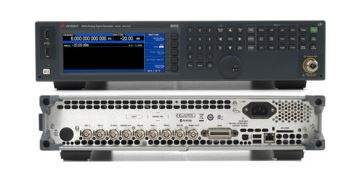
The Keysight MXG X-Series comprises the N5181B analog and N5182B vector signal generators — RF sources covering 9 kHz to 3 or 6 GHz, extendable to 7.2 GHz on the N5182B with the N5182BX07 Frequency Extender. Keysight describes the MXG as a “golden transmitter” for R&D, fine-tuned to deliver phase noise, ACPR, and channel coding performance for engineers pushing for a linear RF chain or an optimized link budget.
The MXG generates standards-based test signals for receiver and transmitter characterization. Distortion and EVM performance is documented for 3GPP W-CDMA, 3GPP LTE-FDD, GSM/EDGE, 3GPP2 cdma2000, 802.16e Mobile WiMAX, and 802.11a/g/ac formats. Avionics test signals — VOR, ILS localizer and glide slope, and marker beacon — are available with Option 302, and real-time cellular, navigation (GPS, GLONASS, Galileo), and video (DVB, ISDB-T) applications are supported through Signal Studio with the real-time baseband generator (Option 660).
<Keysight Technologies traces its roots to the test and measurement business of Hewlett-Packard, which was spun off as Agilent Technologies in 1999. Agilent's electronic measurement business was then established as Keysight Technologies in 2014, the brand under which this product line is offered today.
The Keysight MXG X-Series is offered in two models that share the same platform but serve different signal-generation needs: the N5181B is an analog signal generator, while the N5182B is a vector signal generator that adds I/Q modulation, an internal baseband generator, and arbitrary-waveform playback. Both cover a base range of 9 kHz to 3 or 6 GHz set by frequency options 503 and 506.
Beyond the analog-versus-vector distinction, the family differentiates through options rather than separate hardware tiers. Frequency reach, output power, phase-noise performance, switching speed, and modulation capability are each governed by ordering options, allowing a configuration to be matched to the application. The N5182B uniquely supports extension to 7.2 GHz when paired with the N5182BX07 Frequency Extender.
Each model below links to its own dedicated product page with condition-matched pricing for the new unit you select. Choose the model that matches your required configuration, then review that page for its specifications and current availability.
The N5182B is the vector member of the family: it adds the I/Q modulator, internal baseband generator (Options 656 and 657), arbitrary waveform memory, and the real-time and custom modulation options not present on the analog N5181B. It is also the only model in the series that can be extended to 7.2 GHz via the N5182BX07 Frequency Extender.
The primary difference between the two models is modulation architecture: the N5181B provides analog modulation (AM, FM, and ΦM with Option UNT, pulse with Option UNW), while the N5182B adds full vector/I-Q modulation, baseband generation, and waveform playback on top of those analog capabilities. The comparison table below summarizes the capabilities that apply to each model.
Within each model, frequency range is set by Option 503 (to 3 GHz) or Option 506 (to 6 GHz), output power can be raised with Option 1EA, and phase noise can be improved with Option UNX or UNY. The N5182B carries a higher maximum power draw (300 W versus 160 W) and slightly greater net weight, reflecting its added baseband and vector hardware. Refer to each model's row for the exact options it supports.
| Model | Frequency Range | Type | Max Output Power (>10 MHz–3 GHz, Std) |
|---|---|---|---|
| N5181B | 9 kHz to 3 or 6 GHz | Analog | +18 dBm |
| N5182B | 9 kHz to 6 GHz (7.2 GHz w/ N5182BX07) | Vector | +18 dBm |
Additional differences in specifications beyond the few shown above are not listed here — see each model's full specifications below.
| Specification | Value |
|---|---|
| Frequency | |
| Frequency range (Option 503) | 9 kHz (5 MHz I/Q mode) to 3 GHz |
| Frequency range (Option 506) | 9 kHz (5 MHz I/Q mode) to 6 GHz |
| Frequency range (Option 506 + FRQ, N5182B only) | 9 kHz (5 MHz I/Q mode) to 7.2 GHz |
| Resolution | 0.001 Hz |
| Phase offset | Adjustable in nominal 0.1° increments |
| Frequency Switching Speed | |
| CW mode, SCPI (Standard) | ≤ 5 ms, typical |
| CW mode, SCPI (Option UNZ) | ≤ 1.15 ms |
| List/step sweep mode (Standard) | ≤ 5 ms, typical |
| List/step sweep mode (Option UNZ) | ≤ 900 µs |
| Frequency Reference | |
| Internal timebase aging rate | < ± 1 x 10⁻⁷/year; < ± 5 x 10⁻¹⁰/day after 30 days |
| Initial achievable calibration accuracy | ± 4 x 10⁻⁸ or ± 40 ppb |
| Adjustment resolution | < 1 x 10⁻¹⁰ |
| Temperature effects | < ± 2 x 10⁻¹⁰, nominal |
| Reference output frequency | 10 MHz |
| Reference output amplitude | ≥ +4 dBm, nominal into 50 Ω load |
| External reference input (standard) | 10 MHz |
| External reference input (Option 1ER) | 1 to 50 MHz (in multiples of 0.1 Hz) |
| Lock range | ± 1 ppm |
| Sweep Modes (Frequency and Amplitude) | |
| Operating modes | Step sweep; List sweep |
| Dwell time | 100 µs to 100 s |
| Number of points | 2 to 65535 (step sweep); 1 to 3201 (list sweep) |
| Triggering | Free run, trigger key, external, timer, bus (GPIB, LAN, USB) |
| Output Parameters | |
| Settable range (Standard) | +19 to –144 dBm |
| Settable range (Option 1EA) | +30 to –144 dBm |
| Resolution | 0.01 dB |
| Step attenuator | 0 to 130 dB in 5 dB steps, electronic type |
| Connector | Type N 50 Ω, nominal |
| Maximum Output Power (Standard / Option 1EA) | |
| 9 kHz to 10 MHz | +13 dBm / +17 dBm (+18 dBm typ) |
| > 10 MHz to 3 GHz | +18 dBm / +24 dBm (+26 dBm typ) |
| > 3 to 5 GHz | +16 dBm / +19 dBm (+20 dBm typ) |
| > 5 to 6.0 GHz | +16 dBm / +18 dBm (+19 dBm typ) |
| Absolute Level Accuracy in CW Mode (ALC on, Max power to –60 dBm) () = typical | |
| 100 kHz to 5 MHz | ± 0.8 dB (± 0.3) |
| > 5 MHz to 3 GHz | ± 0.6 dB (± 0.3) |
| > 3 to 6 GHz | ± 0.6 dB (± 0.3) |
| SWR (measured CW mode, Bypass attenuator state) | |
| ≤ 1.0 GHz | < 1.3:1 |
| > 1.0 to 2 GHz | < 1.55:1 |
| > 2 to 3 GHz | < 1.8:1 |
| > 3 to 4 GHz | < 1.5:1 |
| > 4 to 6 GHz | < 1.9:1 |
| Maximum Reverse Power, nominal | |
| < 1 GHz | 50 W |
| > 1 to 2 GHz | 25 W |
| > 2 to 6 GHz | 20 W |
| Max DC voltage | 50 VDC |
| Trip level | 2 W |
| Standard Absolute SSB Phase Noise (dBc/Hz, CW, at 20 kHz offset) () = typical | |
| 5 MHz to < 250 MHz | –129 (–133) |
| 250 MHz | –140 (–143) |
| 500 MHz | –135 (–139) |
| 1 GHz | –131 (–134) |
| 2 GHz | –124 (–127) |
| 3 GHz | –123 (–127) |
| 4 GHz | –118 (–122) |
| 6 GHz | –116 (–121) |
| Option UNX Absolute SSB Phase Noise (dBc/Hz, CW, at 20 kHz offset) () = typical | |
| 5 MHz to < 250 MHz | –140 (–143) |
| 250 MHz | –144 (–150) |
| 500 MHz | –143 (–150) |
| 1 GHz | –141 (–146) |
| 2 GHz | –135 (–141) |
| 3 GHz | –131 (–137) |
| 4 GHz | –118 (–122) |
| 6 GHz | –117 (–121) |
| Harmonics (CW mode) | |
| 9 kHz to 3 GHz (Standard < +4 dBm) | < –35 dBc |
| > 3 to 4 GHz (Standard < +4 dBm) | < –35 dBc, typical |
| > 4 to 6 GHz (Standard < +4 dBm) | < –53 dBc, typical |
| 9 kHz to 3 GHz (Option 1EA < +12 dBm) | < –30 dBc |
| Spurious (CW mode) | |
| Residual FM (300 Hz to 3 kHz BW, CCITT, rms), 5 MHz to 6 GHz | < N x 2 Hz (measured) |
| Residual AM (0.3 to 3 kHz BW, rms, +5 dBm), 100 kHz to 3 GHz | < 0.01% (measured) |
| Analog Modulation (Option UNT) | |
| FM maximum deviation | N × 4 MHz, nominal |
| FM resolution | 1 Hz, nominal |
| FM deviation accuracy | < ± 2% + 20 Hz (1 kHz rate, deviation is N x 50 kHz) |
| Phase modulation maximum deviation, normal bandwidth | N × 2 radians, nominal |
| Phase modulation maximum deviation, high-bandwidth mode | N × 0.2 radians, nominal |
| AM maximum depth | 100% |
| AM depth resolution | 0.1% of depth (nom) |
Important: Maximum reverse power (nominal): 50 W below 1 GHz, 25 W from 1 to 2 GHz, and 20 W from 2 to 6 GHz. Maximum DC voltage: 50 VDC. Reverse power trip level: 2 W.
Important: 7.2 GHz frequency coverage is available only on the N5182B with Option 506 and the N5182BX07 Frequency Extender.
Important: Digital baseband input/output (Options 003 and 004) require the N5102A digital signal interface module to deliver or receive complex-modulated digital signals.
Recommended pairing: extend the N5182B to 7.2 GHz with the Keysight N5182BX07 Frequency Extender, which requires Option 506.
This is a brand-new, factory-sealed unit, supplied exactly as it arrives from the manufacturer and backed by the full manufacturer warranty. For the exact configuration, available options, included accessories, or current lead time for your application, our Test Architects can confirm the details before you order.
ValueTronics supplies both new and used test and measurement equipment. New units ship factory-sealed, exactly as received from the manufacturer; every used unit is inspected and functionally verified in-house at our 20,000 sq ft secure facility in Elgin, Illinois before it ships. Our Test Architects can help you select the condition, calibration, and configuration that fit your application.
Please review the Manufacturer's Data Sheet to verify published specifications. Feedback on this webpage is always welcome — please reach out to your Test Architect at any time for questions or concerns. Thank you, we truly appreciate you being our customer.
Model No
Keysight
Condition
Factory New
Manufacturer
Keysight Technologies
Rf_gen_freq
9 kHz to 6 GHz


30+ Years in Business

Secure Payments

Sell Test Equipments

Knowledgeable Staff

On-site Lab
30+ Years in Business
Secure Payments
Sell Test Equipments
Knowledgeable Staff
On-site Lab
Request A Quote