 Chat Live
 Contact Us
 sales@valuetronics.com



🎓 Request a Quote To Get An EDU Discount
Couldn't load pickup availability
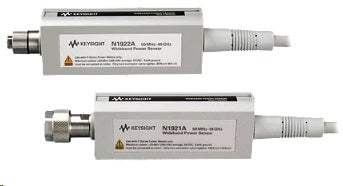
The Keysight N1921A and N1922A are P-Series Wideband Power Sensors used to make accurate RF power measurements. The family comprises two models: the N1921A covers a frequency range of 50 MHz to 18 GHz, while the N1922A extends coverage from 50 MHz to 40 GHz. Each sensor combines with a P-Series power meter to form a complete power measurement system and integrates Keysight's patented internal zeroing and calibration capability directly within the sensor.
These sensors are intended for use in manufacturing and automated test environments, where the ability to zero and calibrate without disconnecting from the device under test reduces test times and connector wear. Because each sensor can be embedded within test fixtures without switching in reference signals, it suits high-throughput production setups. For applications in which the frequency changes often — such as testing multi-carrier amplifiers on different bands — the sensor's modeling approach delivers a marked improvement in measurement speed.
ValueTronics stocks and holds its own inventory in a 20,000 square-foot secure warehouse at 1675 Cambridge Drive in Elgin, Illinois. That lets engineers and labs source the right instrument with confidence, backed by people who know the equipment.
Keysight Technologies traces its origins to Hewlett-Packard, whose test-and-measurement business was spun off as Agilent Technologies in 1999. That measurement business was then established as Keysight Technologies in 2014, the brand under which these instruments are produced today.
The P-Series Wideband Power Sensor line consists of two models that share the same internal zeroing and calibration architecture but differ in frequency coverage and connector type. The N1921A operates from 50 MHz to 18 GHz, and the N1922A operates from 50 MHz to 40 GHz.
Both models pair with a P-Series power meter and rely on the same four-dimensional factory-calibration model stored in EEPROM, so the measurement workflow is consistent across the family. Selection between the two comes down to the upper frequency limit and the connector interface required by the application.
Each model below links to its own dedicated product page with condition-matched pricing for new units. Select the model whose frequency coverage and connector match your measurement system, then choose the listing that fits your requirements and budget.
The primary difference between the two models is frequency coverage: the N1921A reaches 18 GHz, while the N1922A extends to 40 GHz. The connector interface differs accordingly — the N1921A uses a Type-N (male) connector and the N1922A uses a 2.4 mm (male) connector, as shown in the comparison table.
Maximum SWR also differs across the upper bands. Both models specify a maximum SWR of 1.2 from 50 MHz to 10 GHz and 1.26 from 10 GHz to 18 GHz; the N1922A additionally specifies 1.3 from 18 GHz to 26.5 GHz and 1.5 from 26.5 GHz to 40 GHz. See the comparison table for the per-model values.
| Model | Frequency Range | Connector Type | Max SWR |
|---|---|---|---|
| N1921A | 50 MHz to 18 GHz | Type-N (male) | 1.26 |
| N1922A | 50 MHz to 40 GHz | 2.4 mm (male) | 1.5 |
Additional differences in specifications beyond the few shown above are not listed here — see each model's full specifications below.
| Specification | Value |
|---|---|
| General | |
| Frequency range | 50 MHz to 18 GHz |
| Power range | -30 dBm to +20 dBm |
| Connector (to DUT) | Type-N (male) |
| Wrench size | 3/4-inch open-end |
| Torque value | 12 in-lb (135 Ncm) |
| Sensor cable | Permanently connected (hard-wired) |
| Video bandwidth (signals below 500 MHz) | 15 MHz |
| Recommended calibration interval | 1 year |
| Maximum SWR | |
| 50 MHz to 10 GHz | 1.2 |
| 10 GHz to 18 GHz | 1.26 |
| Maximum Test System Uncertainty | |
| 50 MHz to 500 MHz | 3.5% |
| >500 MHz to 1 GHz | 2.7% |
| >1 GHz to 10 GHz | 2.9% |
| >10 GHz to 18 GHz | 3.3% |
| Power Accuracy Verification Specification (Sensor Calibration Uncertainty + Maximum Test System Uncertainty) | |
| 50 MHz to 500 MHz | 8% |
| >500 MHz to 1 GHz | 6.7% |
| >1 GHz to 10 GHz | 6.9% |
| >10 GHz to 18 GHz | 8.3% |
| System-Level Rise and Fall Time | |
| Rise/fall time | ≤13 ns |
| Overshoot | <5% |
Important: Subjecting a power sensor above its maximum allowable power rating is considered misuse and is excluded from Keysight's standard warranty coverage.
Important: The P-Series Wideband Power Sensors are ONLY compatible with the P-Series Power Meters.
Important: A 2.4 mm (f) to N-type (m) adapter is required to perform a manual confidence check against an external 1 mW, 50 MHz power reference (the sensor is fitted with a 2.4 mm (m) connector); this adapter is not shipped together with the P-Series Wideband Power Sensor.
Important: Before connecting the power sensor to other instruments, ensure that all instruments are connected to the protective (earth) ground; any interruption of the protective earth grounding will cause a potential shock hazard that could result in personal injury.
Important: A torque wrench must be used to tighten the DUT connector; only use a wrench set to the correct torque value (N1921A: 12 in-lb / 135 Ncm; N1922A: 8 in-lb / 90 Ncm).
Important: Clean the connector only at a static-free workstation; electrostatic discharge to the center pin of the connector will render the power sensor inoperative. The RF connector beads deteriorate when contacted by hydrocarbon compounds such as acetone, trichloroethylene, carbon tetrachloride, and benzene.
Important: Between 50 MHz and 500 MHz the sensor switches in additional filtering, which results in a 15 MHz video bandwidth limitation for signals below 500 MHz.
This is a brand-new, factory-sealed unit, supplied exactly as it arrives from the manufacturer and backed by the full manufacturer warranty. For the exact configuration, available options, included accessories, or current lead time for your application, our Test Architects can confirm the details before you order.
ValueTronics supplies both new and used test and measurement equipment. New units ship factory-sealed, exactly as received from the manufacturer; every used unit is inspected and functionally verified in-house at our 20,000 sq ft secure facility in Elgin, Illinois before it ships. Our Test Architects can help you select the condition, calibration, and configuration that fit your application.
Please review the Manufacturer's Data Sheet to verify published specifications. Feedback on this webpage is always welcome — please reach out to your Test Architect at any time for questions or concerns. Thank you, we truly appreciate you being our customer.
Model No
Keysight
Condition
Factory New
Manufacturer
Keysight Technologies
Rf_sens_freq
50 MHz to 18.5 GHz
N1912A Keysight RF Power Meter New
N1912A
N1911A Keysight RF Power Meter New
N1911A
Keysight N1922A 50 MHz to 40 GHz P-Series Wideband Power Sensor
N1922A


30+ Years in Business

Secure Payments

Sell Test Equipments

Knowledgeable Staff

On-site Lab
30+ Years in Business
Secure Payments
Sell Test Equipments
Knowledgeable Staff
On-site Lab
Request A Quote

