Chat Live
 Contact Us
 sales@valuetronics.com


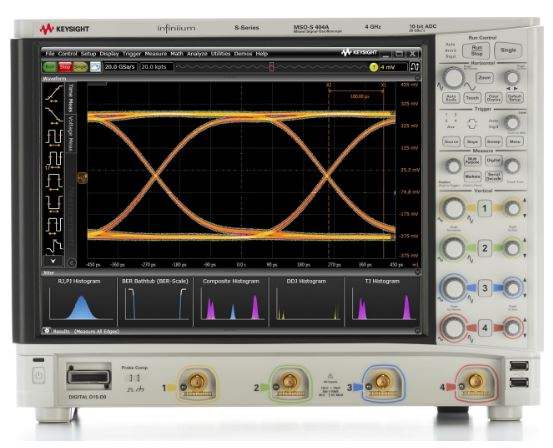
The Infiniium S-Series is a family of oscilloscopes built around superior signal integrity, combining an advanced time base, a low-noise front end, and a 10-bit ADC technology block. The platform delivers up to 16 bits of resolution, low noise, low jitter, and high ENOB, giving visibility into the true performance of a device under test. The series spans seven bandwidth points from 500 MHz to 8 GHz, with every model providing four analog channels and the choice of a digital-storage (DSO) or mixed-signal (MSO) configuration.
An oscilloscope captures voltage waveforms over time, letting an engineer visualize a signal's amplitude, frequency, timing, and shape. The S-Series is positioned for engineers who must debug a design or verify compliance, where it is critical that the oscilloscope displays a true representation of the signal. It is applied to high-speed serial interface design and validation, jitter characterization, power-integrity analysis, eye-diagram and PAM-3/PAM-4 work, and wideband RF measurements, with a broad suite of high-speed digital debug and design tools.
The MSO configuration extends this to evaluating control-signal relationships, data buses up to 16 bits wide, and protocol trigger and decode for buses such as I²C, SPI, RS-232, JTAG, and USB.
To support those workflows it offers comprehensive signal integrity applications, including setup wizards that walk through each measurement setting, an equalization wizard for opening closed eyes on fast data streams, and a crosstalk analysis application (D9020ASIA) for determining the effects of aggressors on a signal. Jitter tests, eye diagrams, and similar measurements can be configured automatically from the Analyze menu, reducing overall test time.
ValueTronics stocks and holds its own inventory in a 20,000 sq ft secure warehouse at 1675 Cambridge Drive in Elgin, Illinois. Holding inventory in our own facility lets us match the right instrument and condition to your application and ship it quickly.
Keysight Technologies traces its test-and-measurement lineage to Hewlett-Packard, whose instrument business was spun off as Agilent Technologies in 1999 and then established as the independent Keysight Technologies in 2014. The Infiniium product name has carried across that history.
The Infiniium S-Series is a single oscilloscope family spanning bandwidths from 500 MHz to 8 GHz, with every model sharing the same core architecture: four analog channels, a 10-bit ADC, a low-noise front end, and the Infiniium user interface on a Windows 10 PC-based platform. Each model is offered in a digital-storage (DSO) or mixed-signal (MSO) configuration, the latter adding 16 digital channels.
Because the models share the platform, the difference between them is primarily headline bandwidth and the corresponding rise-time and ENOB figures, plus the DSO-versus-MSO choice. Bandwidth and MSO functionality can both be added after purchase with a software license key or the N2901E MSO upgrade.
Each new model below is its own dedicated product page with condition-matched pricing. Select the model whose bandwidth and configuration fit your application, then choose the listing that matches the condition you need.
The models differ chiefly by analog bandwidth, which steps from 500 MHz (DSOS054A/MSOS054A) through 1, 2, 2.5, 4, and 6 GHz up to 8 GHz (DSOS804A/MSOS804A). Higher bandwidth corresponds to faster typical 10/90% rise time and a lower full-bandwidth ENOB figure, as shown in the comparison table that follows.
On the 6 GHz and 8 GHz models, the rated bandwidth is supported in two-channel mode; with all four channels active the maximum bandwidth is 4 GHz. DSO models can be upgraded to MSO models, adding 16 digital channels. Refer to the comparison table for each model's bandwidth, rise time, and ENOB values.
| Model | Bandwidth | Analog Channels | Digital Channels |
|---|---|---|---|
| MSOS404A | 4 GHz | 4 | 16 |
| DSOS054A | 500 MHz | 4 | 0 |
| MSOS054A | 500 MHz | 4 | 16 |
| DSOS104A | 1 GHz | 4 | 0 |
Additional differences in specifications beyond the few shown above are not listed here — see each model's full specifications below.
| Specification | Value |
|---|---|
| Tier-Specific Analog Characteristics | |
| Input channels | 4 analog, 16 digital |
| Bandwidth (-3 dB), 50 Ω | 4 GHz |
| Bandwidth (-3 dB), 1 MΩ | 500 MHz |
| Typical rise/fall time (10/90%) | 107.5 ps |
| Typical rise/fall time (20/80%) | 77.5 ps |
| ENOB (typical, not using high-resolution mode) | 7.2 |
| RMS Noise Floor (VRMS AC, 50 Ω inputs, not using high-resolution) | |
| 1 mV/div, 2 mV/div | 153 µV |
| 5 mV/div | 173 µV |
| 10 mV/div | 220 µV |
| 20 mV/div | 330 µV |
| 50 mV/div | 768 µV |
| 100 mV/div | 1.6 mV |
| 200 mV/div | 3.4 mV |
| 500 mV/div | 7.3 mV |
| 1 V/div | 12.5 mV |
| Acquisition & System | |
| Sample Rate | 20 GSa/s on two channels, 10 GSa/s on four channels |
| Standard Memory | 100 Mpts/ch, upgradeable up to 400 Mpts/ch |
| RF Noise Density | -160 dBm/Hz |
| SFDR | 72 dB |
| Display Size | 15" XGA Capacitive Touchscreen, VGA and Display Port for External Monitors |
Important: Maximum input voltage: 50 Ω path ±5 V; 1 MΩ path 30 VRMS or ±40 VMAX (DC+VPEAK). The included N2873A 10:1 probe supports 300 VRMS or ±400 VMAX (DC+VPEAK). No transient overvoltage is allowed in either the 50 Ω or 1 MΩ path, with or without probes.
Important: 6 GHz and 8 GHz bandwidth is supported only when two channels are active; with all four channels on, maximum bandwidth is 4 GHz (applies to DSOS604A/MSOS604A and DSOS804A/MSOS804A).
Important: The DSA option (DSOS001-DSA) can only be installed on new units. Adding DSA functionality post-purchase (N2113A-200 + D9010JITA) is not the same as the new-unit DSA option and is subject to a support subscription.
Important: DDR3 compliance testing on an S-Series is limited to 1600 MT/s.
Important: All existing DSO models are user-upgradable to MSO with part N2901E; the required upgrade time is less than 5 minutes.
Recommended pairing: use the N7020A or N7024A power rail probe with the D9010POWA Power Integrity application for power-integrity measurement and analysis.
Important: Full-bandwidth ENOB and noise floor figures are typical specifications measured at full bandwidth without high-resolution mode enabled; they are not warranted.
Usage tip: for higher-bandwidth measurements, pair the S-Series with the active InfiniiMax 1130/31/32/34B single-ended or differential probes (1.5–7 GHz) from the supported probe family.
This is a brand-new, factory-sealed unit, supplied exactly as it arrives from the manufacturer and backed by the full manufacturer warranty. For the exact configuration, available options, included accessories, or current lead time for your application, our Test Architects can confirm the details before you order.
ValueTronics supplies both new and used test and measurement equipment. New units ship factory-sealed, exactly as received from the manufacturer; every used unit is inspected and functionally verified in-house at our 20,000 sq ft secure facility in Elgin, Illinois before it ships. Our Test Architects can help you select the condition, calibration, and configuration that fit your application.
Please review the Manufacturer's Data Sheet to verify published specifications. Feedback on this webpage is always welcome — please reach out to your Test Architect at any time for questions or concerns. Thank you, we truly appreciate you being our customer.
Model No
Keysight
Condition
Factory New
Manufacturer
Keysight
Osc_ch
4 Analog + 16 Digital
Osc_freq
4 GHz
Osc_r
50 Ω / 1 MΩ
Osc_sampl
20 GSa/s (2 ch), 10 GSa/s (4 ch)


30+ Years in Business

Secure Payments

Sell Test Equipments

Knowledgeable Staff

On-site Lab
30+ Years in Business
Secure Payments
Sell Test Equipments
Knowledgeable Staff
On-site Lab
Request A Quote