Chat Live
 Contact Us
 sales@valuetronics.com


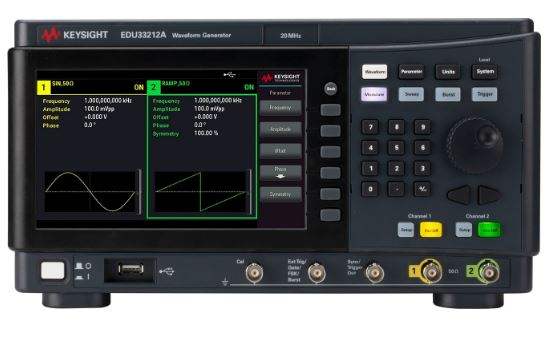
The Keysight EDU33210 Series is a family of 20 MHz function and arbitrary waveform generators offered in two configurations: the single-channel EDU33211A and the dual-channel EDU33212A. Both models combine standard signal-generation capabilities — modulation, sweep, and burst — with a 7-inch WVGA color display that shows waveform parameters, signal preview, and channel status in a single view. Color-coded keypads, display fields, and output connectors are used to help prevent setup and connection errors during bench operation.
The EDU33210 Series is built to generate the stimulus signals needed for circuit characterization, modulation testing, and arbitrary waveform playback. Typical applications supported by the built-in waveform set include cardiac signal simulation, exponential rise and fall responses, Gaussian pulse generation, haversine and Lorentz pulse generation, and pseudorandom binary sequence (PRBS) data patterns. The six built-in modulation types — AM, FM, PM, FSK, BPSK, and PWM — let a single instrument cover analog modulation, simple digital keying, and pulse-width modulation tasks without external equipment.
Keysight Technologies was established in 2014 as the spin-off of Agilent Technologies' electronic measurement business. Agilent itself was created in 1999 when Hewlett-Packard separated its test-and-measurement, semiconductor, and life-science businesses from its computing operations. The Keysight name now carries forward the function and arbitrary waveform generator product heritage that originated under the HP and Agilent brands.
The Keysight EDU33210 Series consists of two 20 MHz function / arbitrary waveform generators that share the same waveform library, modulation capabilities, arbitrary waveform memory architecture, display, and connectivity. The two models are differentiated by channel count: the EDU33211A provides one output channel, and the EDU33212A provides two output channels with coupled, combined, equal, and differential operating modes.
Both models offer the same 17 built-in waveforms, six modulation types (AM, FM, PM, FSK, BPSK, PWM), 16-bit arbitrary waveform resolution, 250 MSa/s maximum sample rate, 8 MSa-per-channel memory depth, USB and LAN interfaces, and 7-inch WVGA color display. Selecting between them is primarily a question of whether the application requires one channel or two.
Each new model below has its own product page with condition-matched pricing and availability. Selecting the correct page for the channel-count configuration the application requires keeps the quote aligned with the unit that will actually ship.
The single distinguishing specification between the two models in this family is channel count. The EDU33211A is the single-channel configuration, suitable for applications that require one independent stimulus output. The EDU33212A is the dual-channel configuration and adds two-channel operating modes including independent, coupled-parameter, combined, equal, and differential operation, with a relative-phase range of 0° to 360° in 0.1° steps.
All other specifications listed in the datasheet — including frequency ranges per waveform type, amplitude range and accuracy, modulation types and parameters, arbitrary waveform memory depth and resolution, sweep and burst capabilities, sync and trigger I/O, and remote-control interfaces — apply to both models in the family. The comparison table below summarizes the channel-count difference.
| Model | Max Frequency | Channels | Arb Memory |
|---|---|---|---|
| EDU33212A | 20 MHz | 2 | 8 MSa/ch |
| EDU33211A | 20 MHz | 1 | 8 MSa/ch |
Additional differences in specifications beyond the few shown above are not listed here — see each model's full specifications below.
| Category | Specification | Value |
|---|---|---|
| Waveforms | ||
| Standard waveforms | Types | Sine, square, ramp, pulse, triangle, Gaussian noise, pseudorandom binary sequence (PRBS), DC |
| Built-in arbitrary | Types | Cardiac, exponential fall, exponential rise, Gaussian pulse, haversine, Lorentz, D-Lorentz, negative ramp, sinc |
| User-defined arbitrary | Memory | Up to 8 MSa per channel; with up to 1 MSa per waveform |
| Operating Modes and Modulation | ||
| Operating modes | Modes | Continuous, modulate, frequency sweep, gated burst |
| Modulation types | Types | AM, FM, PM, FSK, BPSK, PWM |
| Sine | ||
| Frequency range | Range | 1 µHz to 20 MHz, 1 µHz resolution |
| Amplitude flatness (spec, rel. 1 kHz) | 1 Vpp ≤ Vout ≤ 10 Vpp (50 Ω) | f ≤ 100 kHz: ±0.1 dB; 100 kHz < f ≤ 5 MHz: ±0.15 dB; 5 MHz < f ≤ 20 MHz: ±0.3 dB |
| Harmonic distortion (typical) | 1 Vpp ≤ Vout ≤ 10 Vpp (50 Ω) | f ≤ 100 kHz: -60 dBc; 100 kHz < f ≤ 1 MHz: -50 dBc; 1 MHz < f ≤ 20 MHz: -40 dBc |
| THD (typical) | f = 10 Hz to 20 kHz | < 0.075% |
| Non-harmonic spurious (typical) | Level | f ≤ 2 MHz: < -70 dBc; f > 2 MHz: < -70 dBc + 20 dB/decade |
| Phase noise (SSB, typical) | 10 kHz offset | -105 dBc/Hz |
| Square and Pulse | ||
| Frequency range | Range | 1 µHz to 10 MHz, 1 µHz resolution |
| Rise and fall times (nominal) | Square / Pulse | Square: 8.4 ns fixed; Pulse: 8.4 ns to 1 µs, independently variable, 100 ps resolution |
| Overshoot (typical) | Level | ≤ 3% |
| Duty cycle | Range | 0.01% to 99.99%, 0.01% resolution |
| Pulse width | Minimum | 16 ns minimum (adjustable with 100 ps resolution) |
| Jitter (rms, measured) | Value | ≤ 5 MHz: 2 ppm of period + 100 ps; > 5 MHz: 100 ps |
| Ramp and Triangle | ||
| Frequency range | Range | 1 µHz to 200 kHz, 1 µHz resolution |
| Ramp symmetry | Range | 0% to 100%, 0.1% resolution |
| Linearity (typical) | Value | ≤ 0.1% from 5% to 95% of signal amplitude (Vout ≥ 1 Vpp) |
| Gaussian Noise | ||
| Variable bandwidth | Range | 1 MHz to 20 MHz |
| Crest factor (nominal) | Value | 4.6 |
| Repetition period | Value | > 50 years |
| PRBS | ||
| Bit rate | Range | 1 Mbps to 50 Mbps, 1 Mbps resolution |
| Sequence length | Value | 2^m - 1, m = 7, 9, 11, 15, 20, 23 |
| Rise and fall times | Value | 8.4 ns to 1 µs, independently variable, 100 ps resolution |
| Arbitrary Waveforms | ||
| Waveform length | Value | 8 Sa to 8 MSa per channel (max 1 MSa per waveform) |
| Sample rate | Range | 1 µSa/s to 250 MSa/s, 1 µSa/s resolution |
| Voltage resolution | Value | 16 bits |
| Output (General) | ||
| Connector | Type | Front-panel BNC, chassis-referenced |
| Function | States | On, off, or inverted |
| Output impedance (nominal) | Value | 50 Ω |
| Overload protection | Behavior | Output turns off automatically when overload applied; tolerates short circuit to ground indefinitely |
| Amplitude | ||
| Range | Into 50 Ω / open circuit | 1 mVpp to 10 Vpp (50 Ω); 2 mVpp to 20 Vpp (open circuit); 4-digit resolution |
| Units | Selectable | Vpp, Vrms, or dBm |
| Accuracy at 1 kHz sine (spec) | Value | ± (2% of setting in Vpp) ± (1 mVpp) |
| Accuracy at 1 kHz sine (typical) | Value | ± (1% of setting in Vpp) ± (1 mVpp) |
| Voltage limit function | Behavior | User-definable maximum and minimum voltage limits |
| DC Offset | ||
| Range | Into 50 Ω / open circuit | ± (5 VDC minus peak AC) into 50 Ω; ± (10 VDC minus peak AC) into open circuit; 4-digit resolution |
| Accuracy (specification) | Value | ± (1% of offset setting) ± (1% of amplitude in Vpp) ± (5 mV) |
| Frequency Accuracy | ||
| Standard reference (1 year, 23 °C ± 5 °C) | Accuracy | ± (1 ppm of setting + 15 pHz) |
| Standard reference (1 year, 0 °C to 55 °C) | Accuracy | ± (2 ppm of setting + 15 pHz) |
| Amplitude Modulation (AM) | ||
| Depth | Range | 0% to 120%, 0.01% resolution |
| Frequency Modulation (FM) | ||
| Source | Type | Internal only |
| Carrier waveform | Types | Sine, square, ramp, arb |
| Source | Type | Internal only |
| Carrier waveform | Types | Sine, square, ramp, arb |
| Modulating waveform | Types | Sine, square, ramp, noise, arb |
Please review the Manufacturer's Data Sheet to verify published specifications. Feedback on this webpage is always welcome — please reach out to your Test Architect at any time for questions or concerns. Thank you, we truly appreciate you being our customer.
Model No
Keysight
Condition
New
Manufacturer
Keysight
Frequency
20 MHz


30+ Years in Business

Secure Payments

Sell Test Equipments

Knowledgeable Staff

On-site Lab
30+ Years in Business
Secure Payments
Sell Test Equipments
Knowledgeable Staff
On-site Lab
Request A Quote