Chat Live
 Contact Us
 sales@valuetronics.com


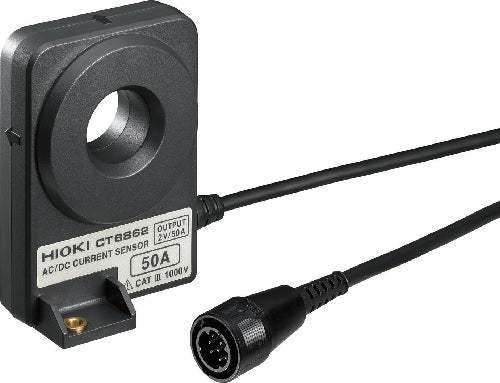
The HIOKI CT6862, CT6863, and 9709 are wide-bandwidth, high-precision AC/DC current sensors that achieve high-accuracy measurement of both small- and large-current signals. Each model provides an isolated current input that converts the measured conductor current into a proportional voltage output — 2 V at the rated current — with a 50 Ω output resistance, allowing the measured signal to be carried to a connected power meter without the long signal-cable effects of a direct connection.
Across the series these sensors support a wide variety of applications in the fields of electric and hybrid electric vehicles, inverters and other devices, and alternative energy sources such as solar power and fuel cells, as well as home electronic appliances and system equipment. They are also suited to comprehensive evaluation of wide-bandwidth, high-precision inverter motors, and to measurements including battery charge and discharge and inverter secondary-circuit measurement.
ValueTronics stocks and holds its own inventory in a 20,000 sq ft secure warehouse at 1675 Cambridge Drive in Elgin, Illinois, so the instruments you order are units we keep on hand rather than sourced on demand.
The HIOKI AC/DC current sensor series comprises three models — the CT6862, CT6863, and 9709 — that share a common high-precision, wide-bandwidth measurement approach but differ in rated current and frequency characteristics. All three deliver a 2 V output at rated current, a 50 Ω output resistance, and the same basic accuracy specification, and all carry a maximum rated voltage to earth of AC/DC 1000 V at measurement category III.
Each model is also offered in a standard version and a -05 version with a 12-pin terminal, giving the CT6862 / CT6862-05, CT6863 / CT6863-05, and 9709 / 9709-05 order codes. The choice between models is driven primarily by the current level and bandwidth a given measurement requires.
Each model below links to its own dedicated product page with new-condition pricing. Select the model that matches your required rated current and bandwidth, then choose the new unit on that model's page.
The models are distinguished by rated current and bandwidth: the CT6862 is rated at 50 A AC/DC with a bandwidth of DC to 1 MHz, the CT6863 at 200 A AC/DC with DC to 500 kHz, and the 9709 at 500 A AC/DC with DC to 100 kHz. Higher rated current in the series corresponds to a lower upper bandwidth limit, so the model selection balances the current to be measured against the frequency content of interest.
Mechanical and conductor-handling differences accompany the electrical tiers, including measurable conductor diameter (26 mm or less, and 36 mm or less depending on model) and physical size and mass. See the comparison table that follows for the per-model rated current, bandwidth, output, dimensions, and accuracy-guarantee period.
| Model | Rated Current | Bandwidth | Output Voltage |
|---|---|---|---|
| CT6862 | 50 A AC/DC | DC to 1 MHz | 2 V/50 A |
| CT6863 | 200 A AC/DC | DC to 500 kHz | 2 V/200 A |
| CT6863 | 200 A AC/DC | DC to 500 kHz | 2 V/200 A |
| 9709 | 500 A AC/DC | DC to 100 kHz | 2 V/500 A |
Additional differences in specifications beyond the few shown above are not listed here — see each model's full specifications below.
| Specification | Value |
|---|---|
| Current Sensing | |
| Rated current | 50 A AC/DC |
| Frequency characteristics | DC to 1 MHz |
| Output voltage | 2 V/50 A |
| Output resistance | 50 Ω |
| Measurable conductor diameter | 26 mm (1.02 in.) or less |
| Basic Accuracy | |
| DC, 16 Hz ≤ f ≤ 400 Hz (0°C to 40°C, 80% RH or less) | ±0.05% rdg. ±0.01% f.s. ±0.2 deg |
| DC, 45 Hz ≤ f ≤ 66 Hz (18°C to 28°C, up to 80% RH) | ±0.05% rdg. ±0.01% f.s. ±0.2 deg |
| Period of accuracy guaranteed | Accuracy guaranteed for 1 year, Post-adjustment accuracy guaranteed for 1 year |
| General | |
| Max. rated voltage to earth | AC/DC 1000 V (50/60 Hz) (measurement category III) |
| Cord length | 3 m (9.84 ft) |
| Operating temperature and humidity range | -30°C to 85°C, 80% RH or less (with no condensation) |
| Dimensions | 70W (2.76 in.) × 100H (3.94 in.) × 53D (2.09 in.) mm |
| Mass | 340 g (12.0 oz) |
| Supplied accessories | Instruction manual ×1, Mark bands ×6 |
Important: Maximum rated voltage to earth: AC/DC 1000 V (50/60 Hz), measurement category III (CAT III 1000 V).
Important: Extension Cable 9706 cannot be used in combination with the CT6862/63 or 9277 to 9279.
Important: Both the 9318 and 9705 are required in order to connect to the F/V Unit 8940.
Important: Conversion Cable CT9900 (current sensor connector 10 pins to 12 pins) is required for connecting to the PW6001.
Recommended pairing: use these sensors with the POWER ANALYZER 3390 to reach the maximum ±0.16% accuracy stated for the series.
This is a brand-new, factory-sealed unit, supplied exactly as it arrives from the manufacturer and backed by the full manufacturer warranty. For the exact configuration, available options, included accessories, or current lead time for your application, our Test Architects can confirm the details before you order.
ValueTronics supplies both new and used test and measurement equipment. New units ship factory-sealed, exactly as received from the manufacturer; every used unit is inspected and functionally verified in-house at our 20,000 sq ft secure facility in Elgin, Illinois before it ships. Our Test Architects can help you select the condition, calibration, and configuration that fit your application.
Please review the Manufacturer's Data Sheet to verify published specifications. Feedback on this webpage is always welcome — please reach out to your Test Architect at any time for questions or concerns. Thank you, we truly appreciate you being our customer.
Model No
Hioki
Condition
Factory New
Manufacturer
HIOKI
Curr_prob_freq
DC to 1 MHz


30+ Years in Business

Secure Payments

Sell Test Equipments

Knowledgeable Staff

On-site Lab
30+ Years in Business
Secure Payments
Sell Test Equipments
Knowledgeable Staff
On-site Lab
Request A Quote