Chat Live
 Contact Us
 sales@valuetronics.com


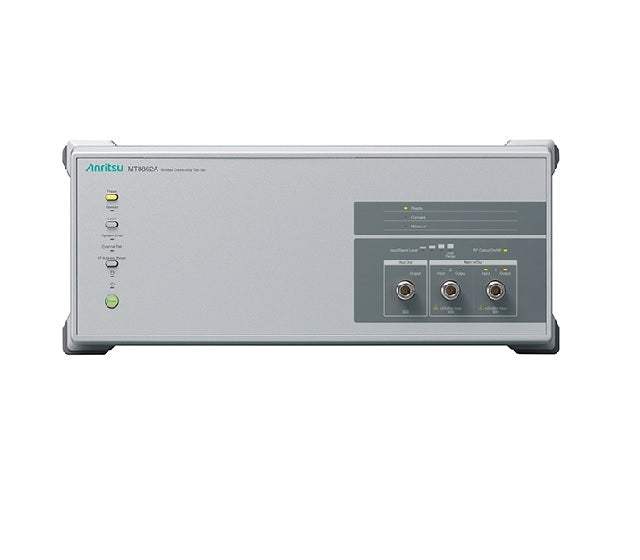
The Anritsu MT8862A Wireless Connectivity Test Set is a benchtop instrument designed for measuring the RF transmit and receive characteristics of WLAN equipment. It uses standard WLAN protocol messaging — referred to as WLAN signalling — to establish a network connection with the device under test before performing RF measurements. This Network Mode capability, together with support for Direct Mode, is the central architectural feature of the platform.
Anritsu identifies the MT8862A's intended applications as design verification and manufacturing inspection of WLAN devices, with end-customer device types including smartphones, tablets, smart appliances, wearable devices, gateways, automotive electronics, and smart grid equipment. The instrument supports both AP-side and STA-side testing: it can simulate an access point to test station-mode devices such as smartphones and PCs, or simulate a station to test access points, routers, and gateways. Over-the-Air (OTA) test setups using anechoic and reverberation chambers are also supported, with Anritsu noting alignment to CTIA and Wi-Fi Alliance CWG recommendations for Total Radiated Power and Total Isotropic Sensitivity measurements.
Anritsu Corporation traces its origins in Japan to 1895 and entered the North American RF and microwave market significantly through its 1990s acquisition of Wiltron, the U.S. network analyzer specialist. Today Anritsu operates as a global precision measurement company headquartered in Atsugi, Japan, with strong installed bases in wireless infrastructure, cellular base station test, and avionics radio test.
| Category | Specification |
|---|---|
| Receiver | |
| Frequency Range | 2.4 GHz to 2.5 GHz, 5.0 GHz to 6.0 GHz (with MT8862A-001 installed) |
| Frequency Setting Resolution | 1 Hz |
| Frequency Accuracy | Depends on reference oscillator accuracy |
| Level Setting Range | −65 to +25 dBm |
| Level Setting Resolution | 0.1 dB |
| Level Accuracy (300 kHz BW, 2.4–2.5 GHz) | ±0.7 dB (−30 dBm ≤ Setting Level ≤ +25 dBm); ±0.9 dB (−55 dBm ≤ Setting Level < −30 dBm); ±1.1 dB (−65 dBm ≤ Setting Level < −55 dBm) |
| Level Accuracy (300 kHz BW, 5.0–6.0 GHz) | ±0.7 dB (−30 dBm ≤ Setting Level ≤ +25 dBm); ±0.9 dB (−55 dBm ≤ Setting Level < −30 dBm); ±1.1 dB (−65 dBm ≤ Setting Level < −55 dBm) |
| Level Accuracy (160 MHz BW, 2.4–2.5 GHz) | ±0.7 dB (−30 dBm ≤ Setting Level ≤ +25 dBm); ±1.0 dB (−50 dBm ≤ Setting Level < −30 dBm) |
| Level Accuracy (160 MHz BW, 5.0–6.0 GHz) | ±0.7 dB (−30 dBm ≤ Setting Level ≤ +25 dBm); ±1.0 dB (−50 dBm ≤ Setting Level < −30 dBm) |
| Linearity (300 kHz BW) | ±0.2 dB (−55 dBm ≤ Input Level); ±0.4 dB (−65 dBm ≤ Input Level < −55 dBm) |
| Linearity (160 MHz BW) | ±0.4 dB (−40 dBm ≤ Input Level) |
| Transmitter | |
| Output Frequency Range | 2.4 GHz to 2.5 GHz, 5.0 GHz to 6.0 GHz (with MT8862A-001 installed) |
| Setting Resolution | 1 Hz |
| Accuracy | Depends on reference oscillator accuracy |
| Level Setting Range | −120 to 0 dBm |
| Level Setting Resolution | 0.1 dB |
| Level Accuracy (CW, ≥−110 dBm, 20–30°C) | ±1.0 dB, ±0.7 dB (typ.) (2.4–2.5 GHz); ±1.3 dB, ±1.0 dB (typ.) (5.0–6.0 GHz) |
| Signal Purity (Harmonic) | ≤−25 dBc |
| Reference Oscillator | |
| At Start | ±5 × 10⁻⁷ (2 min after power-on); ±5 × 10⁻⁸ (5 min after power-on) |
| Aging Rate | ±1 × 10⁻⁷/year |
| Temperature Characteristics | ±2 × 10⁻⁸ (5°C to 45°C) |
| Shipped Frequency Accuracy | ±2.2 × 10⁻⁸ (1 hour after power-on at 20°C to 30°C) |
| Front Panel Connectors | |
| Main1, 2 Connector | N-J, 50Ω (nominal) |
| Main1, 2 VSWR | ≤1.5 (2.4–2.5 GHz); ≤1.7 (5.0–6.0 GHz) |
| Aux Out Connector | N-J, 50Ω (nominal) |
| Aux Out VSWR | ≤1.5 (2.4–2.5 GHz); ≤1.6 (5.0–6.0 GHz) |
| Back Panel Connectors | |
| External Reference Input | BNC-J; 10 MHz; 50Ω; Operation range ±1 ppm; Input Level −15 to +20 dBm (AC coupled) |
| Reference Signal Output | BNC-J; 10 MHz; 50Ω; Output Level ≥0 dBm (AC coupled) |
| Trigger Input 1/2 | BNC 1/2; Input Level TTL |
| Trigger Output 1/2 | BNC 1/2; Output Level TTL |
| Ethernet (Remote) | RJ-45; 1000BASE-T |
| USB | USB-A, 2 Ports; USB 2.0 |
| Expansion I/O | 50 pin (DX10A-50S) |
| Ethernet (IP Data) | RJ-45; 1000BASE-T |
| General | |
| Dimensions | 426 (W) × 177 (H) × 390 (D) mm (excluding projections) |
| Mass | ≤14 kg |
| Rated Voltage | 100 V(ac) to 120 V(ac) or 200 V(ac) to 240 V(ac) |
| Rated Frequency | 50 Hz/60 Hz |
| Power Consumption | ≤350 VA |
| Operating Temperature | +5°C to +45°C |
| Storage Temperature | −20°C to +60°C |
| EMC | EN61326-1, EN61000-3-2 |
| LVD | EN61010-1 |
| RoHS | EN50581 |
| MX886200A WLAN Measurement Software | |
| Frequency Range | 2.4 GHz Band: 2412 MHz to 2484 MHz; 5 GHz Band: 5180 MHz to 5825 MHz |
| Amplitude Input Level Range | −50 to +25 dBm |
| Amplitude Input Level Accuracy | ±0.7 dB (−30 dBm ≤ Input Level ≤ +25 dBm); ±1.0 dB (−50 dBm ≤ Input Level < −30 dBm) [20°C to 30°C, after calibration] |
| Amplitude Linearity | ±0.4 dB (−40 dBm ≤ Input Level, 0 to −30 dB range) |
| Bandwidth | 40 MHz/20 MHz (802.11n); 20 MHz (802.11a/b/g); 80/40/20 MHz (802.11ac, with MX886200A-001) |
| Spectrum Input Level Range | −10 to +25 dBm |
| EVM Measurement Range | −20 to +25 dBm |
| Residual EVM (DSSS) | <−28 dB |
| Residual EVM (OFDM 802.11a/g/n) | <−40 dB |
| Residual EVM (OFDM 802.11ac, with MX886200A-001) | <−38 dB |
| Residual EVM (OFDM 802.11ax, with MX886200A-002) | <−42 dB (nom.) |
Please review the Manufacturer's Data Sheet to verify published specifications. Feedback on this webpage is always welcome — please reach out to your Test Architect at any time for questions or concerns. Thank you, we truly appreciate you being our customer.
Model No
Anritsu
Condition
Used
Manufacturer
Anritsu


30+ Years in Business

Secure Payments

Sell Test Equipments

Knowledgeable Staff

On-site Lab
30+ Years in Business
Secure Payments
Sell Test Equipments
Knowledgeable Staff
On-site Lab
Request A Quote