Chat Live
 Contact Us
 sales@valuetronics.com


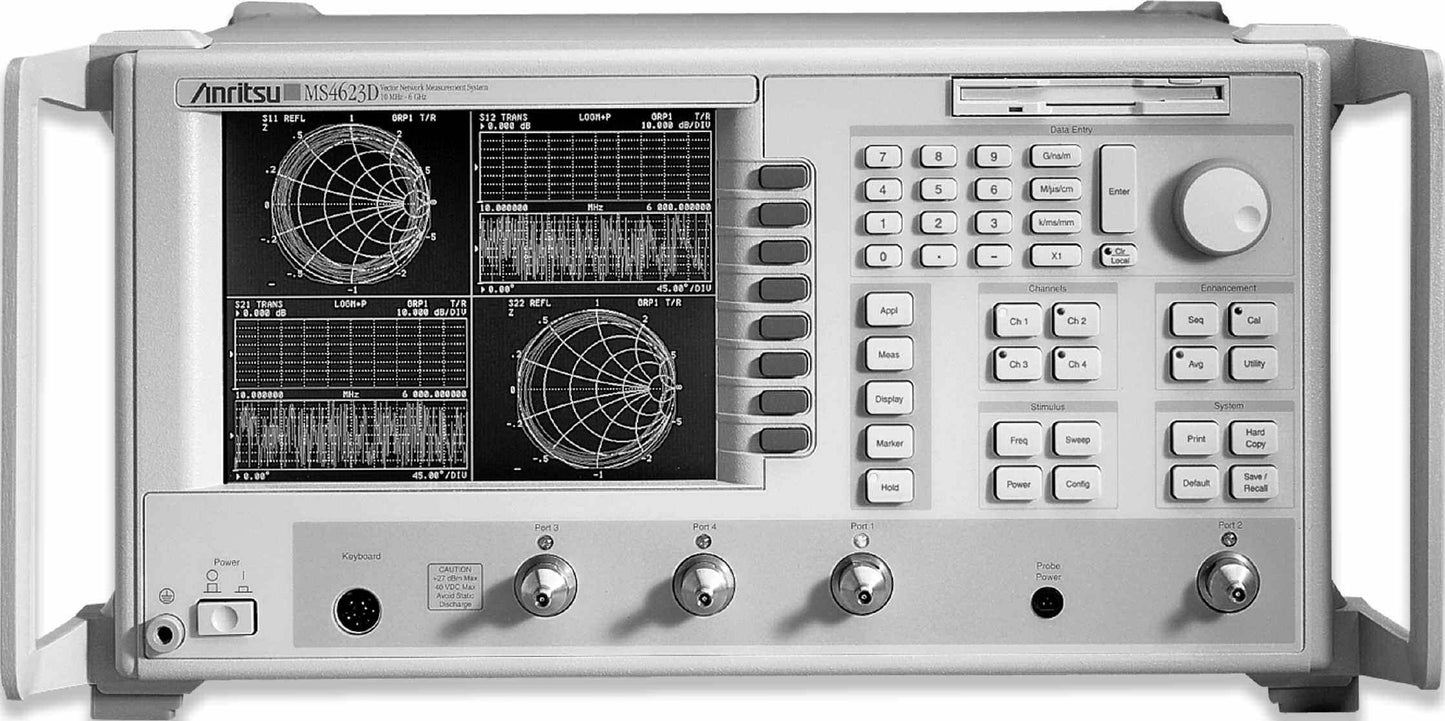
The Scorpion is a vector network measurement system that completely characterizes wireless components and systems across a 10 MHz to 9 GHz range. Positioned as a single analyzer capable of performing a broad span of RF measurements, it brings S-parameter, time domain, and a range of active- and frequency-translating-device measurements together in one instrument so a single connection to the device under test can reveal its true performance.
The system is built to test the complete range of RF components and systems, including antennas, isolators, filters, duplexers, and couplers; SAW filters and baluns; amplifiers; mixers; power amplifiers; tower mount amplifiers; and multiport components. It serves both R&D and manufacturing requirements, with configurations addressing high-volume passive RF testing as well as the more complex demands of active and balanced/differential device characterization.
ValueTronics stocks and holds its own inventory in a 20,000 sq ft secure warehouse at 1675 Cambridge Drive in Elgin, Illinois. Every used unit is inspected and functionally verified in-house before it ships, while new units ship factory-sealed exactly as received from the manufacturer. Holding inventory directly lets our team match the right instrument and configuration to an engineer's application and ship it quickly.
The Microwave Measurement Division behind the Scorpion line traces to Wiltron Company, which Anritsu acquired in 1990; the Wiltron name was retired in favor of Anritsu later that decade.
The Scorpion family is available in three frequency ranges and several port configurations, letting you specify only what an application requires. The MS4622x covers 10 MHz to 3 GHz, the MS4623x covers 10 MHz to 6 GHz, and the MS4624x covers 10 MHz to 9 GHz, with 2-, 3-, and 4-port options within each range.
The family is organized into the economy 'A' family for transmission/reflection 2-port measurements, the full-featured 'B' family for 2- and 3-port S-parameter measurements of passive, active, and frequency-translating components, and the 'D' family for balanced/differential 4-port measurements. The ME7840A is a Scorpion-based power amplifier test system associated with the 'C' configuration.
Each pre-owned model below is its own dedicated product page with condition-matched pricing. Select the specific model and configuration that matches your frequency range and port requirements to see its availability and price.
The models differ primarily by frequency range and number of test ports. Frequency tiers are 3 GHz (MS4622x), 6 GHz (MS4623x), and 9 GHz (MS4624x); within each tier, configurations span 2, 3, and 4 ports as shown in the comparison table that follows.
Capability also differs by family suffix: the 'A' configuration provides transmission/reflection S11 and S21 measurements, the 'B' family adds 2- and 3-port S-parameters with embedding/de-embedding and arbitrary impedance, and the 'D' family adds 4-port S-parameters and mixed-mode S-parameters for balanced/differential devices. Refer to each model's row in the comparison table for its specific measurement set.
| Model | Frequency Range | Test Ports | Family |
|---|---|---|---|
| MS4623D | 10 MHz - 6 GHz | 4 | Balanced/Differential (D) |
| MS4622A | 10 MHz - 3 GHz | 2 | Economy (A) |
| MS4622B | 10 MHz - 3 GHz | 2 to 3 | Full-Featured (B) |
| MS4622C | 10 MHz - 3 GHz | n (multiport) | Power Amplifier / Multiport (C) |
Additional differences in specifications beyond the few shown above are not listed here — see each model's full specifications below.
| Specification | Value |
|---|---|
| Performance Highlights | |
| Measurement Speed | 150 µsec/point |
| Dynamic Range | 125 dB (typical) |
| Source Power | to +10 dBm |
| Receiver Noise | As low as –115 dBm |
| S-Parameter Uncertainty | < 0.05 dB |
| Frequency Range by Model | |
| MS4622x | 10 MHz – 3 GHz |
| MS4623x | 10 MHz – 6 GHz |
| MS4624x | 10 MHz – 9 GHz |
| “B” Family Characteristics | |
| Source Power | Between +7 and –85 dBm |
| Receiver Noise | Typical –115 dBm |
| Calibration | |
| Error Models | 12, 24, and 40-term error models (true 2, 3 and 4-Port calibrations) |
| AutoCal | AutoCal® (3658 series AutoCal modules) for 2, 3 and 4-Port calibrations to 9 GHz |
| Test Port / Connectors | |
| Connectors | N-Type, 3.5 mm, or GPC-7 |
| External Storage | External SCSI Interface |
| Amplifier Measurements | |
| S-Parameters | < ± 0.05 dB Accuracy |
| Gain Compression | As High As +16 dBm |
| Noise Figure | Less than 0.5 dB, 50 MHz to 6 GHz |
| Third Order Intercept | Up to +40 dBm |
| Mixer Measurements | |
| S-Parameters | ± 0.05 dB Accuracy |
| Compression | 20 dB Power Sweep, +7 dBm Source Power |
| Noise Figure | Less than 0.5 dB, 50 MHz to 6 GHz |
| Group Delay Trace Noise | Up to 100 nS peak-to-peak Resolution |
| Third Order Intercept | Up to +40 dBm |
| Mixer IF Frequency | Receivers optionally extended down to 10 kHz |
| ME7840A Power Amplifier Test System Measurements | |
| Frequency / Power | 800 MHz to 2400 MHz (100W); 10 MHz to 6000 MHz (5W) |
| S-Parameters Accuracy | ±0.1 dB Accuracy |
| Compression | 20 dB Power Sweep, +7 dBm Source Power, 800 MHz to 6 GHz |
| Third Order Intercept | Up to +40 dBm |
| Dynamic Range | to 70 dB ACPR (W-CDMA) |
| Power Amplifier Handling | Handles 100 Watts |
| Frequency (MHz) | Directivity (dB) | Source Match (dB) | Load Match (dB) | Directivity Raw (dB) | Port Match Raw (dB) |
|---|---|---|---|---|---|
| 10-1000 | >46 | >44 | >46 | 23 dB | 15 dB |
| 1000-3000 | >44 | >41 | >44 | 23 dB | 15 dB |
| 3000-6000 | >38 | >39 | >38 | 20 dB | 15 dB |
| 6000-9000 | >37 | >36 | >37 | 15 dB | 9 dB |
Important: Using pairs of 2-port calibrations instead of a true 4-port calibration increases measurement uncertainty, which can exceed 0.5 dB.
Important: MS462xD models with Noise Figure Options 4F or 4G have port match (raw) performance degraded below 100 MHz.
Important: Mixer characterization requires an external Anritsu MG3690A synthesizer to provide LO drive; up to four synthesizers can be managed with Multiple Source Control for advanced frequency-translating measurements.
Important: Intermodulation Distortion (IMD) measurements require the connection of an external power combiner.
Important: Power amplifier (ME7840A / PATS) measurements require a high power test set with the Direct Receiver Access (DRA) configuration.
Important: For higher frequency requirements, refer to Anritsu's 37000 Family of Microwave Vector Network Analyzers.
This pre-owned unit is inspected and functionally verified in-house before it ships and is backed by our pre-owned warranty. To confirm its exact condition, firmware revision, installed options, or included accessories for your application before ordering, contact our Test Architects.
ValueTronics supplies both new and used test and measurement equipment. New units ship factory-sealed, exactly as received from the manufacturer; every used unit is inspected and functionally verified in-house at our 20,000 sq ft secure facility in Elgin, Illinois before it ships. Our Test Architects can help you select the condition, calibration, and configuration that fit your application.
Please review the Manufacturer's Data Sheet to verify published specifications. Feedback on this webpage is always welcome — please reach out to your Test Architect at any time for questions or concerns. Thank you, we truly appreciate you being our customer.
Model No
Anritsu
Condition
Pre-Owned
Manufacturer
Anritsu
Net_ana_freq
10 MHz to 6 GHz
11SF
Replaces N female with 3.5mm female Test Port Adapters
13
Intermodulation Distortion3
2
Time Domain
4G
6 GHz Noise Figure1
5
Frequency Translating Group Delay (FTGD)
8
Harmonic Measurement
98
Z540/Guide 25 Calibration


30+ Years in Business

Secure Payments

Sell Test Equipments

Knowledgeable Staff

On-site Lab
30+ Years in Business
Secure Payments
Sell Test Equipments
Knowledgeable Staff
On-site Lab
Request A Quote