Chat Live
 Contact Us
 sales@valuetronics.com


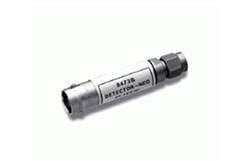
The Agilent 8473C Low Barrier Schottky Diode Detector is part of a family of high-performance diode detectors that covers the 10 MHz to 26.5 GHz frequency range. The family includes the 423B (10 MHz to 12.4 GHz, Type N male), the 8470B (10 MHz to 18 GHz, APC-7 or Type N male), the 8472B (10 MHz to 18 GHz, SMA male), the 8473B (10 MHz to 18 GHz, 3.5 mm male), and the 8473C (10 MHz to 26.5 GHz, 3.5 mm male). Each detector uses a Low Barrier Schottky Diode specially fabricated with low origin resistance and low junction capacitance, which yields improved broadband flatness and SWR relative to point-contact diode detectors.
These detectors are widely used for CW and pulsed power detection, leveling of sweepers, and frequency-response testing of other microwave components. The datasheet identifies additional applications including accurate measurement of transmission and reflection characteristics in CW or swept-frequency measurements, use with a coupler or power splitter to externally level a source, displaying pulsed-RF and AM-modulated signals, and use in closed-loop leveling circuits in microwave instrumentation for OEM and systems applications. Because no DC bias is required, the detectors can be used directly with common oscilloscopes.
ValueTronics supports buyers of the Agilent 423B, 8470B, 8472B, and 8473B/C detector family from its 20,000 square foot secure warehouse at 1675 Cambridge Drive, Elgin, Illinois. Inventory is held, inspected, and prepared for shipment by in-house staff rather than drop-shipped from distant warehouses, which gives customers a single point of accountability for condition, configuration, and post-sale support.
Agilent Technologies was spun off from Hewlett-Packard in 1999 as the test and measurement business, and the electronic measurement portfolio transitioned to Keysight Technologies in 2014. Detectors carrying the Agilent label, including the 423B and 847x family documented here, originate from this lineage.
The Low Barrier Schottky Diode Detector family spans five models that share a common diode technology, 50 Ω characteristic impedance, negative output polarity, BNC female video output, and the same vibration and shock environmental ratings. What differs across the family is upper frequency coverage, connector type, broadband flatness specification, maximum SWR specification, physical size, and weight.
Within the family, the 423B is the Type N model covering 10 MHz to 12.4 GHz, the 8470B is the APC-7 (Option 701) or Type N (Option 012) model to 18 GHz, the 8472B is the SMA model to 18 GHz, the 8473B is the 3.5 mm model to 18 GHz, and the 8473C extends 3.5 mm coverage to 26.5 GHz. Selecting between them is primarily a question of required frequency range and the connector that matches the surrounding system.
Each model in the family is listed on its own product page. pre-owned pricing and availability are shown per model, so the 423B page, 8470B page, 8472B page, 8473B page, and 8473C page each reflect the specific configuration and connector for that model.
The 8473C is the broadest-coverage member of the family, with a specified frequency range of 10 MHz to 26.5 GHz and a 3.5 mm male input connector. Its broadband flatness is specified as ±0.3 dB from 10 MHz to 12.4 GHz, ±0.6 dB from 10 MHz to 20 GHz, and ±1.5 dB from 20 to 26.5 GHz from a 3.3 dB linear slope, with maximum SWR of 1.2 below 4 GHz, 1.5 from 4 to 18 GHz, and 2.2 from 18 to 26.5 GHz. Sensitivity is greater than 0.5 mV/µW from 10 MHz to 18 GHz and greater than 0.18 mV/µW from 18 to 26.5 GHz.
The principal differences across the family are upper frequency limit, broadband flatness, and SWR. The 423B is specified to 12.4 GHz with the tightest SWR (1.15 below 4 GHz, 1.30 to 12.4 GHz). The 8470B, 8472B, and 8473B all reach 18 GHz with slightly different flatness and SWR profiles and different connectors (APC-7/Type N, SMA, and 3.5 mm respectively). The 8473C extends coverage to 26.5 GHz on a 3.5 mm connector, with an associated relaxation in flatness and SWR specifications above 18 GHz.
Physical size and weight also differ. The 423B and 8470B are larger and heavier (114 grams net) than the 8472B (57 grams) and the 8473B/C (14 grams each). All models share the same options structure: -001 for matched response, -002 for optimum square-law load, and -003 for positive polarity output. See the comparison table below for the side-by-side specification view.
| Model | Frequency Range | Max SWR | Input Connector |
|---|---|---|---|
| 8473B | 0.01 to 18 GHz | 1.2 (0.01 to 4 GHz); 1.5 (4 to 18 GHz) | 3.5 mm Male (SMA Compatible) |
| 423B | 0.01 to 12.4 GHz | 1.15 (0.01 to 4 GHz); 1.30 (4 to 12.4 GHz) | Type N Male |
| 8470B | 0.01 to 18 GHz | 1.15 (0.01 to 4 GHz); 1.30 (4 to 15 GHz); 1.70 (15 to 18 GHz) | APC-7 (Option 701); Type N Male (Option 012) |
| 8472B | 0.00 to 18 GHz | 1.20 (0.01 to 4.5 GHz); 1.35 (4.5 to 7 GHz) | SMA Male |
Additional differences in specifications beyond the few shown above are not listed here — see each model's full specifications below.
| Specifications | 423B | 8473B | 8473C | 8470B | 8472B |
|---|---|---|---|---|---|
| Frequency range | 0.01 to 12.4 GHz | 0.01 to 18 GHz | 0.01 to 26.5 GHz | 0.01 to 18 GHz | 0.00 to 18 GHz |
| Octave band flatness (over any octave 0.01 to 8 GHz) | ±0.2 dB | ±0.2 dB | ±0.2 dB | ±0.2 dB | ±0.2 dB |
| Broadband flatness | 0.01 to 12.4 GHz: ±0.3 dB | 0.01 to 12.4 GHz: ±0.3 dB; 0.01 to 18 GHz: ±0.6 dB | 0.01 to 12.4 GHz: ±0.3 dB; 0.01 to 20 GHz: ±6 dB; 20 to 26.5 GHz: ±1.5 dB from a 3.3 dB linear slope | 0.01 to 12.4 GHz: ±0.3 dB; 0.01 to 15 GHz: ±0.5 dB; 0.01 to 18 GHz: ±0.6 dB | 0.01 to 12.4 GHz: ±0.3 dB; 0.01 to 15 GHz: ±0.5 dB |
| SWR, maximum (50Ω characteristic impedance) | 0.01 to 4 GHz: 1.15; 4 to 12.4 GHz: 1.30 | 0.01 to 4 GHz: 1.2; 4 to 18 GHz: 1.5 | 0.01 to 4 GHz: 1.2; 4 to 18 GHz: 1.5; 18 to 26.5 GHz: 2.2 | 0.01 to 4 GHz: 1.15; 4 to 15 GHz: 1.30; 15 to 18 GHz: 1.70 | 0.01 to 4.5 GHz: 1.20; 4.5 to 7 GHz: 1.35 |
| Maximum operating input (Peak or average) | 200 mW | 200 mW | 200 mW | 200 mW | 200 mW |
| Short-term maximum input (less than 1 min.) | 1 watt (typical) | 1 watt (typical) | 1 watt (typical) | 1 watt (typical) | 1 watt (typical) |
| Sensitivity | > 0.5 mV/µW | > 0.5 mV/µW | 0.01 to 18 GHz: > 0.5 mV/µW; 18 to 26.5 GHz: > 0.18 mV/µW | > 0.5 mV/µW | > 0.5 mV/µW |
| Noise (µV peak-to-peak with CW power applied to produce 100 mV output) | < 50 µV | < 50 µV | < 50 µV | < 50 µV | < 50 µV |
| Operating temperature | 0 to 55 °C | -20 °C to +85 °C | -20 °C to +85 °C | -20 °C to +85 °C | -20 °C to +85 °C |
| Vibration | 20 G's, 80 - 2000 Hz | 20 G's, 80 - 2000 Hz | 20 G's, 80 - 2000 Hz | 20 G's, 80 - 2000 Hz | 20 G's, 80 - 2000 Hz |
| Shock | 100 G's, 11 ms | 100 G's, 11 ms | 100 G's, 11 ms | 100 G's, 11 ms | 100 G's, 11 ms |
| Output polarity | Negative | Negative | Negative | Negative | Negative |
| Input connector | Type N Male | 3.5 mm Male (SMA Compatible) | 3.5 mm Male (SMA Compatible) | APC-7 (Option 701); Type N Male (Option 012) | SMA Male |
| Output connector | BNC Female | BNC Female | BNC Female | BNC Female | BNC Female (Option 101); OSSM (Option 100) |
| Video impedance | 1 kΩ to 2 kΩ; 1.3 kΩ (typical) | 1 kΩ to 2 kΩ; 1.3 kΩ (typical) | 1 kΩ to 2 kΩ; 1.3 kΩ (typical) | 1 kΩ to 2 kΩ; 1.3 kΩ (typical) | 1 kΩ to 2 kΩ; 1.3 kΩ (typical) |
| RF bypass capacitor | 20 pF to 60 pF; 30 pF (typical) | 20 pF to 60 pF; 30 pF (typical) | 20 pF to 60 pF; 30 pF (typical) | 20 pF to 60 pF; 30 pF (typical) | 20 pF to 60 pF; 30 pF (typical) |
| Length | 63 mm (2.47 in) | 48 mm (1.89 in) | 43 mm (1.89 in) | 64 mm (2.50 in) | 64 mm (2.50 in) |
| Diameter | 20 mm (0.38 in) | 10 mm (0.39 in) | 10 mm (0.39 in) | 19 mm (0.75 in) | 14 mm (0.56 in) |
| Net weight | 114 g (4 oz) | 14 g (0.5 oz) | 14 g (0.5 oz) | 114 g (4 oz) | 57 g (2 oz) |
| Shipping weight | 454 g (16 oz) | 454 g (16 oz) | 454 g (16 oz) | 454 g (16 oz) | 454 g (16 oz) |
Please review the Manufacturer's Data Sheet to verify published specifications. Feedback on this webpage is always welcome — please reach out to your Test Architect at any time for questions or concerns. Thank you, we truly appreciate you being our customer.
Model No
Agilent
Condition
Used
Manufacturer
Agilent
Frequency
18 GHz


30+ Years in Business

Secure Payments

Sell Test Equipments

Knowledgeable Staff

On-site Lab
30+ Years in Business
Secure Payments
Sell Test Equipments
Knowledgeable Staff
On-site Lab
Request A Quote