Chat Live
 Contact Us
 sales@valuetronics.com


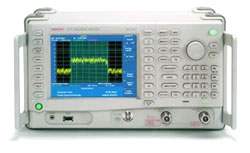
A spectrum analyzer displays the amplitude of signals across a range of frequencies, letting an engineer see how energy is distributed in the frequency domain — carrier levels, spurious content, harmonics, and noise. The Advantest U3741/3751 is a portable spectrum analyzer offered in two frequency tiers: the U3741 covering 9 kHz to 3 GHz and the U3751 covering 9 kHz to 8 GHz. Its digitized IF section delivers improved power-measurement accuracy for digitally modulated signals, and it provides twice the throughput of its predecessor in a light, compact package designed to be carried and used anywhere.
The U3741/3751 supports a wide range of applications, from use on production lines to system installation and maintenance, with three power options that allow measurement in the factory or in the field. The instrument addresses tasks such as channel power measurement for digital signals, EMI noise measurement using CISPR bandwidths, spectrum emission mask testing for standards such as wireless LAN, locating fault points (open/short) in coaxial cable when paired with the tracking generator option, and evaluating the frequency-conversion-loss characteristics of mixers and the return loss of antennas and filters.
ValueTronics stocks and holds its own inventory in a 20,000 square-foot secure warehouse at 1675 Cambridge Drive in Elgin, Illinois, so the test equipment we list is equipment we keep on hand. Every pre-owned unit benefits from that direct-inventory approach: pre-owned instruments are inspected and functionally verified in-house before they ship, while new units ship factory-sealed exactly as received from the manufacturer.
Advantest Corporation traces its origins to Takeda Riken, an instrument maker founded in 1954, and adopted the Advantest name in 1985. The company is headquartered in Tokyo, Japan.
The U3741/3751 is a portable spectrum analyzer family built around a common digitized-IF architecture, a built-in pre-amplifier, and a compact form factor that can be powered from AC, external DC, or a battery pack. The two members differ chiefly in upper frequency limit: the U3741 reaches 3 GHz and the U3751 reaches 8 GHz, with both sharing the same measurement-function set, 6.5-inch color display, and GPIB/USB/LAN interfaces.
Both models target the same kinds of work — production-line testing, system installation, and field maintenance — and both improve power-measurement accuracy on digitally modulated signals while delivering twice the throughput of the previous generation. The choice between them comes down to the frequency span a given application requires.
Each pre-owned model below is listed on its own dedicated product page with condition-matched pricing. Select the model that matches your required frequency range and configuration, then choose the condition that fits your budget and program needs.
The primary difference between the models is frequency coverage: the U3741 spans 9 kHz to 3 GHz, while the U3751 spans 9 kHz to 8 GHz across two bands (9 kHz to 3.1 GHz and 3 to 8 GHz). Absolute amplitude accuracy is ±0.8 dB from 10 MHz to 3 GHz on both, with the U3751 additionally specifying ±1.0 dB from 3.1 to 8 GHz. Maximum safe DC input also differs — ±50 VDC on the U3741 versus ±15 VDC on the U3751.
Configuration options vary as well: the 75 Ω input impedance option (OPT.15) and the 75 Ω tracking generator (OPT.75) are offered on the U3741, while the 50 Ω tracking generator (OPT.76) and other options apply across the family. The U3741 weighs 5 kg or less without options and the U3751 weighs 5.6 kg or less. See the comparison table below for the model-by-model breakdown of these specifications.
| Model | Frequency Range | Resolution Bandwidth | Max DC Input |
|---|---|---|---|
| U3741 | 9 kHz to 3 GHz | 100 Hz to 1 MHz | ±50 VDC max. |
| U3751 | 9 kHz to 8 GHz | 100 Hz to 3 MHz | ±15 VDC max. |
Additional differences in specifications beyond the few shown above are not listed here — see each model's full specifications below.
| Specification | Value |
|---|---|
| Frequency | |
| Frequency range | 9 kHz to 3 GHz, 9 kHz to 2.2 GHz (with the OPT.15 installed) |
| Frequency range (Pre-Amp) | 10 MHz to 3 GHz, 10 MHz to 2.2 GHz (with the OPT.15 installed) |
| Synchronizable frequency range | 9 kHz to 3 GHz |
| Frequency reading accuracy | ± (marker read value × frequency reference accuracy + span × span accuracy + residual FM) |
| Frequency reference stability — Aging rate | ±2 × 10⁻⁶/year |
| Frequency reference stability — Temperature stability | ±2.5 × 10⁻⁶ (0 to 50°C) |
| Frequency counter | At a signal level S/N > 50 dB |
| Frequency counter — Resolution | 1 Hz to 1 kHz |
| Frequency counter — Accuracy | ± (counter read value × frequency reference accuracy + residual FM + 1 LSB) |
| Residual FM (zero/span) | < 60 Hzp-p/100 ms (internal frequency reference) |
| Frequency span | |
| Range | 5 kHz to Full, zero span; 1 kHz to Full, zero span (with the OPT.70 installed) |
| Accuracy | < ±1% |
| Spectrum purity | -85 dBc/Hz (offset 10 kHz, span < 200 kHz) |
| Resolution bandwidth | |
| Range | 100 Hz to 1 MHz (1 to 3 steps); 30 Hz to 1 MHz (with the OPT.70 installed) |
| Accuracy | < ±12% |
| Video bandwidth range | 10 Hz to 3 MHz (1 to 3 steps) |
| Sweep | |
| Sweep time setting range | 20 ms to 1000 s (spectrum mode); 50 µs to 1000 s (zero span) |
| Sweep time accuracy | < ±2% (zero span) |
| Sweep mode | Continuous, single, gated |
| Trigger source | Free run, video, external, IF |
| Amplitude | |
| Measurement range | Noise level to +30 dBm; Noise level to 134 dBµV (with the OPT.15 installed) |
| Maximum safe input level | Attenuator ≥10 dB |
| Maximum safe input level (Pre-Amp OFF) | +30 dBm, 134 dBµV (with the OPT.15 installed) |
| Maximum safe input level (Pre-Amp ON) | +13 dBm, 120 dBµV (with the OPT.15 installed) |
| Maximum safe DC input | ±50 VDC max. |
| Input attenuator range | 0 to 50 dB (10 dB steps) |
| Display range | 100/50/20/10/5 dB, linear |
| Scale unit | dBm, dBmV, dBµV, dBµVemf, dBpW, W, V |
| Reference level setting range | -140 to +40 dBm; -31.2 to 148.8 dBµV (with the OPT.15 installed) |
| Detection mode | Normal, Positive peak, Negative peak, Sample, RMS, and Average |
| Amplitude accuracy | |
| Calibration signal — Frequency | 20 MHz |
| Calibration signal — Level | -20 dBm (75 Ω, with the OPT.15 installed) |
| Calibration signal — Accuracy | ±0.3 dB, ±0.4 dB (with the OPT.15 installed) |
| Scale display accuracy (Log) | ±0.5 dB/10 dB, ±0.5 dB/80 dB, ±0.2 dB/1 dB |
| Overall amplitude accuracy — conditions | After calibration, with the pre-amp OFF, and at a temperature ranging from 20 to 30°C, Input attenuator 10 dB |
| Overall amplitude accuracy (Ref level 0 dBm, input signal -10 to -50 dBm) | ±1.0 dB (9 kHz to 3 GHz); ±0.8 dB (10 MHz to 3 GHz) |
| Overall amplitude accuracy (with OPT.15, Ref level 108.8 dBµV, input 98.8 to 58.8 dBµV) | ±2.1 dB (9 kHz to 2.2 GHz); ±0.9 dB (10 MHz to 2.2 GHz) |
| Dynamic range | |
| Displayed average noise level — conditions | Reference level < -45 dBm (63.8 dBµV, with the OPT.15 installed), Resolution bandwidth 100 Hz |
| Displayed average noise level (Pre-Amp OFF) | -123 dBm + 2f (GHz) dB (f < 2.5 GHz); -123 dBm + 2.5f (GHz) dB (f ≥2.5 GHz); -12 dBµV + 2f (GHz) dB (f ≤2.2 GHz, with the OPT.15 installed) |
| Displayed average noise level (Pre-Amp ON) | -138 dBm + 3f (GHz) dB; -27 dBµV + 3f (GHz) dB (with the OPT.15 installed) |
| 1 dB gain compression — conditions | Frequency > 20 MHz |
| 1 dB gain compression (Pre-Amp OFF) | > -5 dBm; > 102 dBµV (with the OPT.15 installed) |
| 1 dB gain compression (Pre-Amp ON) | > -25 dBm; > 82 dBµV (with the OPT.15 installed) |
| Second harmonic distortion | < -70 dBc (Pre-Amp OFF, Frequency > 20 MHz, Mixer input level -30 dBm (77 dBµV, with the OPT.15 installed)) |
| Third order intermodulation distortion | < -60 dBc (Pre-Amp OFF, Mixer input level -20 dBm (88.8 dBµV, with the OPT.15 installed), Frequency > 10 MHz, 2 signal separation > 200 kHz) |
| Image/multiple/out of band response | < -60 dBc (Mixer input level -20 dBm (88.8 dBµV, with the OPT.15 installed)) |
| Residual response | < -90 dBm (Frequency > 1 MHz, Pre-Amp OFF); < 21 dBµV (with the OPT.15 installed) |
| Inputs/outputs | |
| RF input — Connector | N-type female |
| RF input — Impedance | 50 Ω (nominal); 75 Ω (nominal, with the OPT.15 installed) |
| RF input — VSWR (Input attenuator > 10 dB) | < 1.5 : 1; < 1.6 : 1 (with the OPT.15 installed) |
| Calibration signal output — Connector | BNC female |
| Calibration signal output — Impedance | 50 Ω (nominal); 75 Ω (nominal, with the OPT.15 installed) |
| Calibration signal output — Frequency | 20 MHz |
| Calibration signal output — Level | -20 dBm |
| Frequency reference input — Connector | BNC female |
| Frequency reference input — Impedance | 50 Ω (nominal) |
| Frequency reference input — Frequency (MHz) | 1, 1.544, 2.048, 5, 10, 12.8, 13, 13.824, 14.4, 15.36, 15.4, 16.8, 19.2, 19.44, 19.6608, 19.68, 19.8, 20, 26 |
| Frequency reference input — Level | 0 to +16 dBm |
| External trigger input — Connector | BNC female |
| External trigger input — Impedance | 10 kΩ (nominal), DC coupling |
| External trigger input — Level | 0 to +5 V |
| 21.4-MHz IF output — Connector | BNC female |
Important: Option compatibility: OPT.15 (75 Ω input) and OPT.75 (75 Ω tracking generator) cannot be installed simultaneously; OPT.75 requires OPT.15 and cannot be installed together with OPT.76.
Important: The battery pack is sold separately. The battery mount accepts the battery pack, which provides up to approximately 2.5 hours of continuous battery-driven operation (typical value at room temperature, without options).
Important: The operating manual on the CD (BU3700S) is supplied as standard. The printed version of the operating manual (JU3700S Japanese / EU3700S English) is offered as a separately ordered accessory.
Important: OPT.15 (75 Ω Input Impedance) is available for the U3741 only; the U3751 does not support the 75 Ω input impedance option.
Recommended pairing: add the optional tracking generator (OPT.75, 75 Ω, 100 kHz to 2.2 GHz, or OPT.76, 50 Ω, 100 kHz to 3 GHz) to evaluate cable loss, filter characteristics, and mixer conversion-loss characteristics.
This pre-owned unit is inspected and functionally verified in-house before it ships and is backed by our pre-owned warranty. To confirm its exact condition, firmware revision, installed options, or included accessories for your application before ordering, contact our Test Architects.
ValueTronics supplies both new and used test and measurement equipment. New units ship factory-sealed, exactly as received from the manufacturer; every used unit is inspected and functionally verified in-house at our 20,000 sq ft secure facility in Elgin, Illinois before it ships. Our Test Architects can help you select the condition, calibration, and configuration that fit your application.
Please review the Manufacturer's Data Sheet to verify published specifications. Feedback on this webpage is always welcome — please reach out to your Test Architect at any time for questions or concerns. Thank you, we truly appreciate you being our customer.
Model No
Advantest
Condition
Pre-Owned
Manufacturer
Advantest
Spec_ana_freq
9 kHz to 3 GHz
28
EMC FILTER


30+ Years in Business

Secure Payments

Sell Test Equipments

Knowledgeable Staff

On-site Lab
30+ Years in Business
Secure Payments
Sell Test Equipments
Knowledgeable Staff
On-site Lab
Request A Quote