Chat Live
 Contact Us
 sales@valuetronics.com


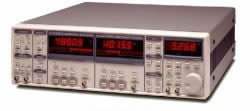
The SR810 and SR830 are DSP lock-in amplifiers. Both instruments use digital signal processing to replace the demodulators, output filters, and amplifiers found in conventional lock-in amplifiers, providing performance over an operating range of 1 mHz to 102.4 kHz with more than 100 dB of drift-free dynamic reserve. The SR830 simultaneously displays the magnitude and phase of a signal, while the SR810 displays the magnitude only.
A lock-in amplifier recovers a signal of interest from a much larger background of interfering signals. In these instruments, demodulation is accomplished by sampling the input with a high-precision A/D converter and multiplying the digitized input by a synthesized reference signal — a digital technique that results in more than 100 dB of true dynamic reserve with no prefiltering and is free of the errors associated with analog instruments. The offset and expand features are useful when examining small fluctuations in a measurement, and the four auxiliary inputs allow tasks such as normalizing the input to source intensity fluctuations.
ValueTronics stocks and holds its own test-and-measurement inventory in a 20,000-square-foot secure warehouse at 1675 Cambridge Drive in Elgin, Illinois. Operating since 1992, we keep instruments on hand so availability can be confirmed and orders shipped promptly. Pre-owned units are inspected and functionally verified in-house before they ship, while new units ship factory-sealed exactly as received from the manufacturer.
The SR810 and SR830 are DSP lock-in amplifiers that use digital signal processing to replace the demodulators, output filters, and amplifiers found in conventional lock-ins. Both operate over a 1 mHz to 102.4 kHz range and deliver more than 100 dB of drift-free dynamic reserve without prefiltering.
The two models share the same signal channel, reference channel, and digital filtering architecture. The SR830 simultaneously displays the magnitude and phase of a signal, while the SR810 displays the magnitude only — the primary distinction within the family.
Each model below is its own dedicated pre-owned product page with condition-matched pricing. Select the SR810 or SR830 page that matches the configuration you need; the shared platform specifications apply to both, while the per-model differences are summarized in the comparison table that follows.
Within the family, the SR830 is the dual-phase instrument: it adds a second user-defined output measuring Y, θ, Y-noise, Aux 3, Aux 4 or ratio, along with a second display channel for those quantities. The SR810 provides a single user-defined output measuring X, R, X-noise, Aux 1 or Aux 2.
Data buffering also differs: the SR810 has an 8,000-point buffer for recording one measurement's time history at rates to 512 samples/s, while the SR830 has two 16k-point buffers to record two measurements simultaneously. The comparison table below details these per-model differences.
| Model | Type | Display Channels | User-Defined Outputs |
|---|---|---|---|
| SR830 | Dual Phase | 2 | 2 |
| SR810 | Single Phase | 1 | 1 |
Additional differences in specifications beyond the few shown above are not listed here — see each model's full specifications below.
| Specification | Value |
|---|---|
| Signal Channel | |
| Voltage inputs | Single-ended or differential |
| Sensitivity | 2 nV to 1 V |
| Current input | 10⁶ or 10⁸ V/A |
| Input impedance (Voltage) | 10 MΩ + 25 pF, AC or DC coupled |
| Input impedance (Current) | 1 kΩ to virtual ground |
| Gain accuracy | ±1 % (±0.2 % typ.) |
| Noise (typ.) | 6 nV/√Hz at 1 kHz; 0.13 pA/√Hz at 1 kHz (10⁶ V/A); 0.013 pA/√Hz at 100 Hz (10⁸ V/A) |
| Line filters | 50/60 Hz and 100/120 Hz (Q = 4) |
| CMRR | 100 dB to 10 kHz, decreasing by 6 dB/oct above 10 kHz |
| Dynamic reserve | >100 dB (without prefilters) |
| Stability | <5 ppm/°C |
| Reference Channel | |
| Frequency range | 0.001 Hz to 102.4 kHz |
| Reference input | TTL or sine (400 mVpp min.) |
| Input impedance | 1 MΩ, 25 pF |
| Phase resolution | 0.01° front panel, 0.008° through computer interfaces |
| Absolute phase error | <1° |
| Relative phase error | <0.001° |
| Orthogonality | 90° ± 0.001° |
| Phase noise (Internal ref.) | Synthesized, <0.0001° rms at 1 kHz |
| Phase noise (External ref.) | 0.005° rms at 1 kHz (100 ms time constant, 12 dB/oct) |
| Phase drift | <0.01°/°C below 10 kHz, <0.1°/°C above 10 kHz |
| Harmonic detection | 2F, 3F, ... nF to 102 kHz (n < 19,999) |
| Acquisition time | (2 cycles + 5 ms) or 40 ms, whichever is larger |
| Demodulator | |
| Stability | Digital outputs and display: no drift. Analog outputs: <5 ppm/°C for all dynamic reserve settings |
| Harmonic rejection | −90 dB |
| Time constants | 10 µs to 30 ks (6, 12, 18, 24 dB/oct rolloff). Synchronous filters available below 200 Hz. |
| Internal Oscillator | |
| Range | 1 mHz to 102 kHz |
| Frequency accuracy | 25 ppm + 30 µHz |
| Frequency resolution | 4½ digits or 0.1 mHz, whichever is greater |
| Distortion | −80 dBc (f <10 kHz), −70 dBc (f >10 kHz) @ 1 Vrms amplitude |
| Amplitude | 0.004 to 5 Vrms into 10 kΩ (2 mV resolution), 50 Ω output impedance, 50 mA maximum current into 50 Ω |
| Amplitude accuracy | 1 % |
| Amplitude stability | 50 ppm/°C |
| Outputs | Sine, TTL (When using an external reference, both outputs are phase locked to the external reference.) |
| Displays | |
| Channel 1 | 4½-digit LED display with 40-segment LED bar graph. X, R, X-noise, Aux 1 or Aux 2. The display can also be any of these quantities divided by Aux 1 or Aux 2. |
| Channel 2 (SR830) | 4½-digit LED display with 40-segment LED bar graph. Y, θ, Y-noise, Aux 3 or Aux 4. The display can also be any of these quantities divided by Aux 3 or Aux 4. |
| Offset | X, Y, R can be offset up to ±105 % of full scale. |
| Expand | X, Y, R can be expanded by 10× or 100×. |
| Reference | 4½-digit LED display |
| Inputs and Outputs | |
| CH1 output | X, R, X-noise, Aux 1 or Aux 2, (±10 V), updated at 512 Hz |
| CH2 output (SR830) | Y, θ, Y-noise, Aux 3 or Aux 4, (±10 V), updated at 512 Hz |
| X, Y outputs | In-phase and quadrature components (rear panel), (±10 V), updated at 256 kHz. |
| Aux. A/D inputs | 4 BNC inputs, 16-bit, ±10 V, 1 mV resolution, sampled at 512 Hz |
| Aux. D/A outputs | 4 BNC outputs, 16-bit, ±10 V, 1 mV resolution |
| Sine out | Internal oscillator analog output |
| TTL out | Internal oscillator TTL output |
| Data buffer | The SR810 has an 8k point buffer. The SR830 has two 16k point buffers. Data is recorded at rates to 512 Hz and read through the computer interfaces. |
| Trigger in (TTL) | Trigger synchronizes data recording |
| Remote preamp | Provides power to the optional SR550, SR552 and SR554 preamps |
| General | |
| Interfaces | IEEE-488.2 and RS-232 interfaces standard. All instrument functions can be controlled and read through IEEE-488.2 or RS-232 interfaces. |
| Power | 40 W, 100/120/220/240 VAC, 50/60 Hz |
| Dimensions | 17" × 5.25" × 19.5" (WHD) |
| Weight | 23 lbs. |
| Warranty | One year parts and labor on defects in materials and workmanship |
Recommended pairing: the rear-panel remote-preamp connector supplies power to the optional SR550 and SR552 voltage preamplifiers and the SR554 transformer preamplifier; the SR540 optical chopper is also listed as a compatible accessory.
This pre-owned unit is inspected and functionally verified in-house before it ships and is backed by our pre-owned warranty. To confirm its exact condition, firmware revision, installed options, or included accessories for your application before ordering, contact our Test Architects.
ValueTronics supplies both new and used test and measurement equipment. New units ship factory-sealed, exactly as received from the manufacturer; every used unit is inspected and functionally verified in-house at our 20,000 sq ft secure facility in Elgin, Illinois before it ships. Our Test Architects can help you select the condition, calibration, and configuration that fit your application.
Please review the Manufacturer's Data Sheet to verify published specifications. Feedback on this webpage is always welcome — please reach out to your Test Architect at any time for questions or concerns. Thank you, we truly appreciate you being our customer.
Model No
Stanford
Condition
Pre-Owned
Manufacturer
Stanford Research Systems


30+ Years in Business

Secure Payments

Sell Test Equipments

Knowledgeable Staff

On-site Lab
30+ Years in Business
Secure Payments
Sell Test Equipments
Knowledgeable Staff
On-site Lab
Request A Quote