Chat Live
 Contact Us
 sales@valuetronics.com


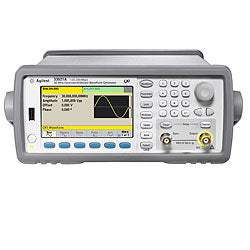
The Agilent 33522A is a two-channel 30 MHz function/arbitrary waveform generator in the 33500 Series, designed to generate sine, square, pulse, ramp, triangle, Gaussian noise, PRBS, and DC waveforms as well as user-defined arbitrary waveforms. The instrument combines a 250 MSa/s sample rate with 16-bit vertical resolution and provides 1 MSa of arbitrary waveform memory per channel as standard, with expansion to 16 MSa available through Option 002.
A function/arbitrary waveform generator creates the controlled stimulus signals used to characterize and verify electronic circuits and systems. The 33522A targets applications cited on its datasheet including dual-tone multi-frequency (DTMF) signal generation for telecommunications device test, and dual-channel testing scenarios such as pacemaker validation where the timing and interaction of two distinct signals must be controlled. The 33500 Series is positioned for both R&D engineers characterizing new designs and test system engineers validating production units.
ValueTronics International has supported the test and measurement community since 1992 and stocks new, used, and refurbished instruments at our 20,000 sq ft secure warehouse at 1675 Cambridge Drive in Elgin, Illinois. Every pre-owned unit moves through our facility for inspection, functional verification, and condition grading by our own technicians before listing—work that drop-shipping resellers and broker marketplaces cannot replicate because they never physically handle the equipment. Buyers who need a signal source backed by a real US facility, a real technician's measurement, and a real phone number for post-sale questions get all three from ValueTronics.
Hewlett-Packard's test and measurement business was spun out as Agilent Technologies in 1999. In 2014, Agilent's electronic measurement business became Keysight Technologies, while Agilent retained life sciences and chemical analysis. Instruments originally branded Agilent—including the 33521A and 33522A—are part of the lineage that continues today under Keysight Technologies.
The Agilent 33500 Series consists of two 30 MHz function/arbitrary waveform generators that share the same core architecture, signal fidelity specifications, and modulation capabilities. Both models deliver 250 MSa/s sample rate, 16-bit vertical resolution, less than 40 ps rms cycle-to-cycle jitter on square and pulse outputs, and less than 0.04% THD on sine outputs from 20 Hz to 20 kHz.
The two models differ in channel count. The 33521A is a single-channel instrument; the 33522A is a two-channel instrument that adds parameter coupling, combined-output, equal-channel, and differential operation modes. Both models accept the same option set: Option 002 (16 MSa memory per channel), Option 010 (OCXO high-stability timebase), and Option 400 (GPIB interface).
Each pre-owned model in the 33500 Series is listed on its own product page with condition-matched pricing. Use the links below to navigate to the model that fits the channel count, options, and budget for your application.
The 33522A is the dual-channel member of the 33500 Series. In addition to all single-channel capabilities, it supports independent operation per channel, parameter coupling (frequency ratio or difference, amplitude, and DC offset), combined output (Ch 1 + Ch 2), equal channels (Ch 2 = Ch 1), and differential operation (Ch 2 = -Ch 1). Relative phase is settable from 0° to 360° in 0.1° steps with typical skew under 200 ps when performing identical operations and typical crosstalk below -85 dB.
The primary architectural difference between the 33521A and 33522A is channel count: one channel versus two. The 33522A's dual-channel modes enable applications that require two phase-correlated or differential signals from a single instrument, including the DTMF and dual-signal device test scenarios cited on the datasheet.
Beyond channel count, both models share identical specifications for bandwidth, sample rate, jitter, THD, modulation capability, memory depth (with the same Option 002 expansion path), connectivity, and operating environment. The comparison table below lists the key parameters that differ between the two models.
| Model | Channels | Bandwidth | Sample Rate |
|---|---|---|---|
| 33521A | 1 | 30 MHz | 250 MSa/s |
| 33522A | 2 | 30 MHz | 250 MSa/s |
Additional differences in specifications beyond the few shown above are not listed here — see each model's full specifications below.
| Category | Specification | Value |
|---|---|---|
| Waveforms | Standard | Sine, square, ramp, pulse, triangle, Gaussian noise, PRBS (Pseudorandom Binary Sequence), DC |
| Built-in arbitrary | Cardiac, exponential fall, exponential rise, Gaussian pulse, Haversine, Lorentz, D-Lorentz, negative ramp, sinc | |
| User-defined arbitrary | Up to 1 MSa (16 MSa with Option 002) with multi-segment sequencing | |
| Operating modes | Continuous, modulate, frequency sweep, burst, output gate | |
| Modulation types | AM, FM, PM, FSK, BPSK, PWM, Sum (carrier + modulation) | |
| Sine | Frequency range | 1 μHz to 30 MHz, 1-μHz resolution |
| Amplitude flatness (relative to 1 kHz) | < 100 kHz: ±0.10 dB; 100 kHz to 5 MHz: ±0.15 dB; 5 to 20 MHz: ±0.30 dB; 20 to 30 MHz: ±0.40 dB | |
| Harmonic distortion (typ) | < 20 kHz: < -70 dBc; 20 to 100 kHz: < -65 dBc; 100 kHz to 1 MHz: < -50 dBc; 1 to 20 MHz: < -40 dBc; 20 to 30 MHz: < -35 dBc | |
| THD (typ) | 20 Hz to 20 kHz: < 0.04% | |
| Non-harmonic spurious (typ) | Standard: < -75 dBc, increasing +20 dB/decade above 2 MHz; Option 010: < -75 dBc, increasing +20 dB/decade above 10 MHz | |
| Phase noise (SSB) (typ) | 1 kHz offset: -105 dBc/Hz (std), -110 dBc/Hz (Opt 010); 10 kHz offset: -115 dBc/Hz (std), -125 dBc/Hz (Opt 010); 100 kHz offset: -125 dBc/Hz (std), -135 dBc/Hz (Opt 010) | |
| Square & Pulse | Frequency range | 1 μHz to 30 MHz, 1 μHz resolution |
| Rise and fall times (nom) | Square: 8.4 ns fixed; Pulse: 8.4 ns to 1 μs, independently variable, 100-ps or 3-digit resolution | |
| Overshoot (typ) | < 2% | |
| Duty cycle | 0.01% to 99.99% | |
| Jitter (cycle-to-cycle, typ) | < 40 ps rms | |
| Ramp & Triangle | Frequency range | 1 μHz to 200 kHz, 1 μHz resolution |
| Ramp symmetry | 0.0% to 100.0%, 0.1% resolution | |
| Nonlinearity (typ) | < 0.05% from 5% to 95% of signal amplitude | |
| Gaussian Noise | Bandwidth (typ) | 1 mHz to 30 MHz, variable |
| Crest factor (nom) | 4.6 | |
| Repetition period | > 50 years | |
| PRBS | Bit rate | 1 mbps to 50 Mbps, 1 mbps resolution |
| Sequence length | 2^m -1, m=7, 9, 11, 15, 20, 23 | |
| Rise and fall times (nom) | 8.4 ns to 1 μs, variable, 100-ps or 3-digit resolution | |
| Arbitrary Waveform | Waveform length | 8 Sa to 1 MSa (16 MSa with Option 002) in increments of 1 sample |
| Sample rate | 1 μSa/s to 250 MSa/s, 1 μSa/s resolution | |
| Voltage resolution | 16 bits | |
| Bandwidth (-3 dB, nom) | Filter Off: 40 MHz; "Normal" Filter On: 0.27 × Sample Rate; "Step" Filter On: 0.13 × Sample Rate | |
| Rise and fall time | 0.35 / Bandwidth (10 ns min) with Normal or Step filter On | |
| Settling time (typ) | < 200 ns to 0.5% of final value | |
| Jitter (typ) | Filter Off: < 40 ps rms; Normal or Step filter On: < 5 ps | |
| Waveform Sequencing | Segment length | 8 Sa to 1 MSa (16 MSa with Option 002) in increments of 1 sample |
| Sequence length | 1 to 512 steps | |
| Segment repeat count | 1 to 1×10^6, or infinite | |
| Signal Output | Output impedance (nom) | 50 Ω |
| Amplitude range | 1 mVpp to 10 Vpp into 50 Ω; 2 mVpp to 20 Vpp into open circuit | |
| Amplitude accuracy (spec) | ±1% of setting ±1 mVpp at 1 kHz | |
| Isolation | Maximum allowable voltage on isolated connector shells is ±42 Vpk | |
| DC Offset | Range | ±(5 VDC - Peak AC) into 50 Ω; ±(10 VDC - Peak AC) into open circuit |
| Resolution | 4 digits | |
| Accuracy (spec) | ±1% of Offset setting ±0.25% of Amplitude setting ±2 mV | |
| Frequency Accuracy | Standard, 1 year, 23°C ± 5°C | ±1 ppm of setting ± 15 pHz |
| Standard, 1 year, 0°C to 55°C | ±2 ppm of setting ± 15 pHz | |
| Option 010, 1 year, 0°C to 55°C | ±0.1 ppm of setting ± 15 pHz | |
| Computer Interfaces | LXI-C (rev 1.3) | 10/100Base-T Ethernet (Sockets & VXI-11 protocol) |
| USB | USB 2.0 (USB-TMC488 protocol) | |
| GPIB | IEEE-488.1, IEEE-488.2 (Option 400) | |
| Web user interface | Remote operation and monitoring | |
| Programming language | SCPI-1999, IEEE-488.2; Agilent 33210A / 33220A compatible | |
| Display | Graphical | 4.3" Color TFT WQVGA (480x272) with LED backlight |
| Mechanical | Size | 261.1 mm W × 103.8 mm H × 303.2 mm D (with bumpers); 212.8 mm W × 88.3 mm H × 272.3 mm D (no bumpers); 2U × ½ rack width |
| Weight (nom) | 3.3 kg (7.2 lbs) | |
| Environmental | Operating temperature | 0°C to 55°C |
| Storage temperature | -40°C to 70°C | |
| Operating humidity | 5% to 80% RH, non-condensing | |
| Operating altitude | up to 3000 meters | |
| Warm-up time | 1 hour | |
| Line Power | Voltage | 100 V - 240 V 50/60 Hz -5%, +10%; 100 V - 120 V 400 Hz ±10% |
| Power consumption (typ) | < 45 W, < 130 VA | |
| Acoustic noise (nom) | SPL 35 dB(A) | |
| Memory | Non-volatile | File system file space limited to 64 MB (~32 MSa of arbitrary waveform records) |
Please review the Manufacturer's Data Sheet to verify published specifications. Feedback on this webpage is always welcome — please reach out to your Test Architect at any time for questions or concerns. Thank you, we truly appreciate you being our customer.
Model No
Agilent
Condition
Used
Manufacturer
Agilent
Frequency
30 MHz


30+ Years in Business

Secure Payments

Sell Test Equipments

Knowledgeable Staff

On-site Lab
30+ Years in Business
Secure Payments
Sell Test Equipments
Knowledgeable Staff
On-site Lab
Request A Quote